


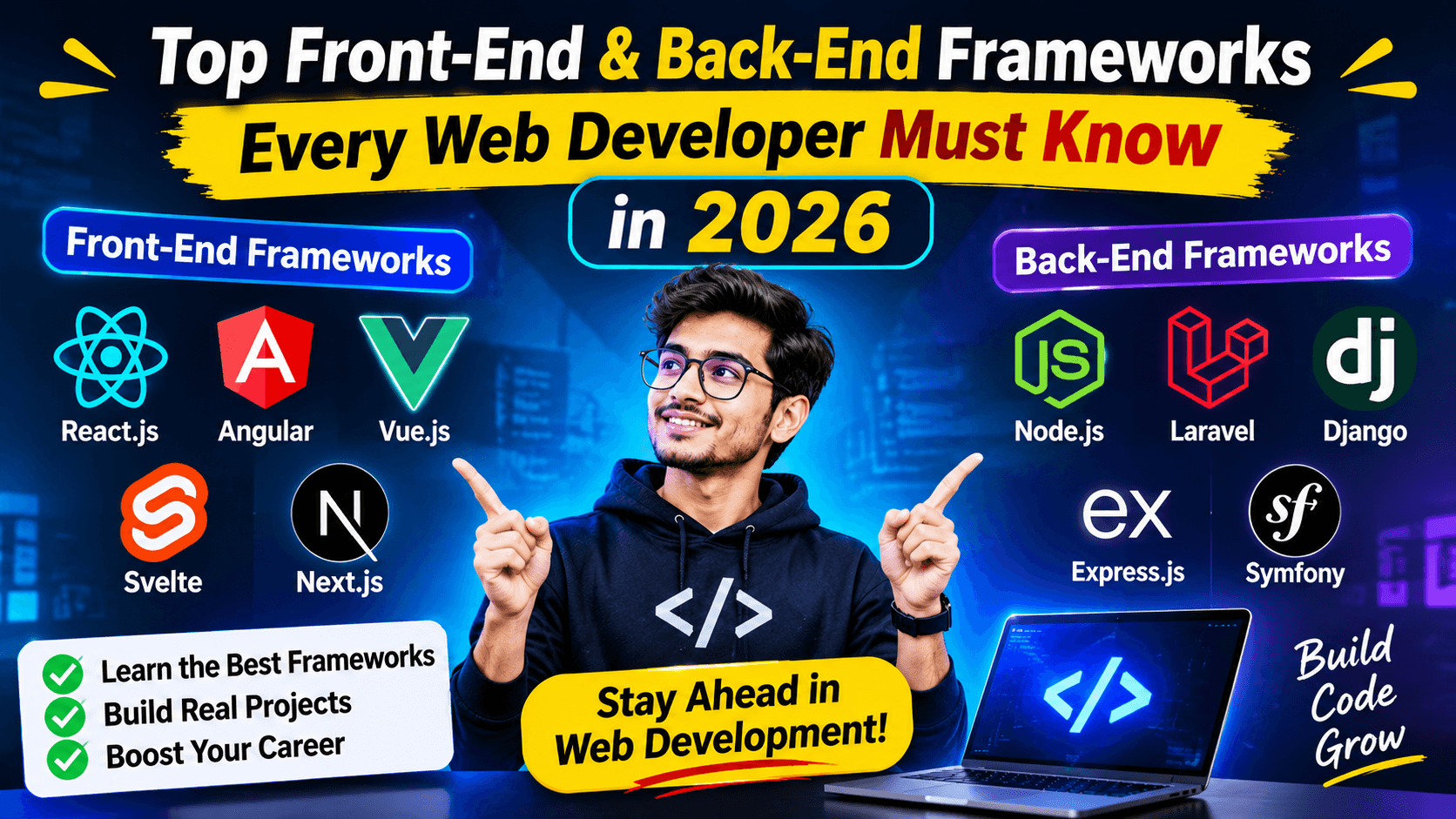
Top Front-End & Back-End Frameworks Every Web Developer Must Know in 2026
Web development continues to evolve as businesses demand faster, more interactive, secure and scalable digital applications. From e-commerce platforms and educational portals to enterprise software and cloud-based applications, modern websites depend on powerful technologies that simplify development and improve performance.
For aspiring developers, choosing the right programming tools is an important step towards building a successful career. Front-end frameworks help developers create attractive and interactive user interfaces, while back-end frameworks handle application logic, databases, authentication and server-side operations.
In 2026, technologies such as React, Angular, Vue.js, Next.js, Node.js, Django and Laravel remain important options for different types of web projects. This guide explores their features, advantages, applications and learning paths.
1. What Are Front-End and Back-End Frameworks?
A framework is a structured collection of tools, libraries, conventions and reusable components that helps developers build applications more efficiently.
Front-End Development
Front-end development focuses on the parts of a website that visitors see and interact with. It includes layouts, navigation menus, buttons, forms, animations, dashboards and responsive designs.
Common front-end technologies include:
HTML for structuring webpage content.
CSS for styling and responsive layouts.
JavaScript for interactive functionality.
React, Angular and Vue.js for building user interfaces.
Next.js for developing React-based applications with additional features.
Back-End Development
Back-end development manages the server-side functionality of an application. It processes requests, handles business logic, communicates with databases and manages authentication.
Popular back-end technologies include:
Node.js with Express.js or NestJS.
Python with Django or FastAPI.
PHP with Laravel.
Java with Spring Boot.
C# with ASP.NET Core.
2. Best Front-End Frameworks and Technologies to Learn in 2026
1. React.js
React is a popular JavaScript library for creating interactive user interfaces. It uses reusable components, allowing developers to divide complex interfaces into smaller and manageable sections.
Important features:
Reusable component architecture.
JSX for combining JavaScript and UI markup.
Hooks for managing state and component behaviour.
Large ecosystem of supporting libraries.
Integration with APIs and back-end services.
Where is React used?
React is commonly used for dashboards, e-commerce interfaces, social applications, business portals and interactive web platforms.
Career opportunities: React Developer, Front-End Developer and JavaScript Developer.
2. Angular
Angular is a TypeScript-based web application framework maintained by Google. It provides a structured development environment with built-in features for routing, forms, dependency injection and application development.
Important features:
Component-based architecture.
TypeScript support.
Dependency injection.
Built-in routing and form tools.
Structured development for larger applications.
Where is Angular used?
Angular is useful for enterprise applications, administrative dashboards, internal business systems and large-scale web platforms.
Career opportunities: Angular Developer, Front-End Engineer and Enterprise Application Developer.
3. Vue.js
Vue.js is a progressive JavaScript framework used to create user interfaces. Its approachable structure makes it suitable for beginners as well as developers working on more advanced applications.
Important features:
Component-based development.
Reactive data binding.
Single-file components.
Flexible integration into existing projects.
Supporting ecosystem for routing and state management.
Where is Vue.js used?
Vue.js can be used for interactive websites, dashboards, content platforms and single-page applications.
Career opportunities: Vue.js Developer and Front-End Web Developer.
4. Svelte
Svelte is a modern UI framework that takes a compiler-based approach to building web applications. It transforms components during the build process, reducing the amount of framework work required in the browser.
Important features:
Compiler-based approach.
Concise component syntax.
Reactive programming model.
Support for building interactive interfaces.
SvelteKit for application development.
Where is Svelte used?
Svelte is suitable for interactive websites, lightweight applications and projects where developers want a streamlined development experience.
5. Next.js
Next.js is a React-based web framework that provides additional capabilities for building full-stack web applications. It supports features such as server rendering, static generation, routing and server-side functionality.
Important features:
File-system-based routing.
Server-side rendering options.
Static site generation.
Server Components and server-side functionality.
Image and performance optimization features.
Where is Next.js used?
Next.js is useful for content-rich websites, e-commerce platforms, business websites, blogs and applications that benefit from flexible rendering strategies.
Career opportunities: Next.js Developer, React Developer and Full Stack Developer.
3. Best Back-End Frameworks and Technologies to Learn in 2026
1. Node.js with Express.js
Node.js is a JavaScript runtime that allows developers to execute JavaScript outside the browser. Express.js is a lightweight web framework commonly used with Node.js to create APIs and server-side applications.
Important features:
JavaScript across frontend and backend.
Lightweight routing and middleware.
REST API development.
Integration with databases.
Large ecosystem of packages through npm.
Where is it used?
Node.js and Express.js are commonly used for web APIs, real-time applications, e-commerce backends and full-stack JavaScript projects.
Career opportunities: Node.js Developer, Backend Developer and Full Stack JavaScript Developer.
2. Django
Django is a high-level Python web framework designed to support rapid development. It includes many built-in features that help developers create secure and maintainable applications.
Important features:
Built-in authentication system.
Object-relational mapping (ORM).
Automatic administrative interface.
URL routing and template system.
Security features and structured project organization.
Where is Django used?
Django is useful for content management platforms, educational portals, data-driven websites, business applications and web services.
Career opportunities: Python Developer, Django Developer and Backend Engineer.
3. Laravel
Laravel is a PHP framework used to develop modern web applications. It provides tools for routing, database operations, authentication, validation and application management.
Important features:
Elegant routing system.
Eloquent ORM for database operations.
Authentication and authorization tools.
Blade templating engine.
Database migrations and queues.
Where is Laravel used?
Laravel is used for business websites, e-commerce platforms, content management systems and custom web applications.
Career opportunities: PHP Developer, Laravel Developer and Backend Web Developer.
4. Spring Boot
Spring Boot is a Java-based framework that simplifies the development of standalone, production-ready applications. It is widely used in enterprise software development and Java-based backend systems.
Important features:
Auto-configuration.
Dependency injection through the Spring ecosystem.
REST API development.
Database integration.
Support for microservices architectures.
Where is Spring Boot used?
Spring Boot is suitable for enterprise platforms, banking applications, business systems, APIs and distributed services.
Career opportunities: Java Developer, Spring Boot Developer and Backend Engineer.
5. ASP.NET Core
ASP.NET Core is a cross-platform framework from Microsoft for building modern web applications and APIs using C# and .NET.
Important features:
Cross-platform development.
High-performance web application capabilities.
Built-in dependency injection.
Middleware-based request processing.
Support for APIs, MVC and real-time applications.
Where is ASP.NET Core used?
It is commonly used for enterprise applications, business platforms, cloud-based systems and web APIs.
Career opportunities: .NET Developer, ASP.NET Core Developer and Software Engineer.
4. Front-End vs Back-End Frameworks: Key Differences
Comparison
Front-End
Back-End
Main purpose
User interface and interaction
Server-side logic and data processing
Common languages
HTML, CSS, JavaScript, TypeScript
JavaScript, Python, PHP, Java, C#
Popular tools
React, Angular, Vue, Svelte
Express, Django, Laravel, Spring Boot
Key responsibilities
Layouts, navigation and user experience
APIs, authentication and databases
Typical roles
Front-End Developer
Back-End Developer
Both areas are essential for complete web applications. Developers who understand frontend and backend technologies can work across the full application development process.
5. Which Framework Should Beginners Learn First?
There is no single framework that is best for every developer. The right choice depends on your interests, programming background and career goals.
For beginners: Start with HTML, CSS and JavaScript before selecting a frontend framework.
For frontend careers: Explore React, Angular or Vue.js.
For JavaScript full-stack development: Learn React or Next.js with Node.js and Express.
For Python development: Learn Python fundamentals before exploring Django or FastAPI.
For PHP development: Understand PHP and databases before learning Laravel.
For enterprise Java development: Learn Java, object-oriented programming and Spring Boot.
Build a strong foundation in programming fundamentals before attempting to learn multiple frameworks at the same time.
6. Practical Projects to Build Using These Frameworks
Practical projects help students understand how frameworks work in real development environments. Consider building the following applications:
1. E-Commerce Website
Build a product catalogue, shopping cart, user login system and order management functionality. Use React or Next.js for the frontend and Node.js, Django or Laravel for the backend.
2. Student Management System
Create a platform to manage student records, attendance, course details and administrative information.
3. Job Portal Application
Develop a website where candidates can explore job listings and recruiters can publish vacancies.
4. Online Learning Platform
Create a learning portal with courses, user accounts, lessons, progress tracking and administrative features.
5. Appointment Booking System
Build a platform that allows users to browse available services, select time slots and manage bookings.
For each project, focus on responsive design, database integration, validation, authentication, testing and deployment.
7. Skills Every Modern Web Developer Should Develop
Knowing a framework is only one part of becoming a professional developer. Employers and development teams also value problem-solving abilities and practical software engineering skills.
HTML, CSS and JavaScript fundamentals.
Programming logic and data structures.
Responsive web design.
API integration and REST principles.
Database management and SQL basics.
Git and GitHub version control.
Debugging and testing.
Basic application security.
Deployment and hosting knowledge.
Communication and teamwork.
8. How to Learn Web Development During Six Months of Industrial Training
A structured six-month learning plan can help students progress from basic programming concepts to complete web applications.
Month 1: HTML, CSS and Web Fundamentals
Learn webpage structure, styling, responsive layouts and basic website design. Build a personal portfolio website.
Month 2: JavaScript Programming
Practise variables, functions, arrays, objects, DOM manipulation, events and API fundamentals. Develop interactive mini-projects.
Month 3: Front-End Frameworks
Choose a frontend path such as React, Angular or Vue. Learn components, state management, routing and API integration.
Month 4: Back-End Development
Choose a backend technology such as Node.js, Django, Laravel or Spring Boot. Learn server-side logic, REST APIs and database connectivity.
Month 5: Full Stack Project Development
Combine frontend and backend skills to build a complete application. Implement authentication, database operations and important project features.
Month 6: Testing, GitHub and Deployment
Test the application, fix bugs, upload code to GitHub and deploy the project using a suitable hosting platform. Prepare project documentation and a portfolio.
9. Career Opportunities After Learning Web Development Frameworks
Learning web development frameworks can prepare students to explore several entry-level and specialized career paths, depending on their practical skills and project experience.
Front-End Developer
Back-End Developer
Full Stack Developer
React Developer
Angular Developer
Node.js Developer
Python Web Developer
PHP Developer
Web Application Developer
Career opportunities vary according to technical ability, portfolio quality, communication skills, location and employer requirements. Building real projects is a useful way to demonstrate your development knowledge.
10. Why Practical Web Development Training Matters
Learning from online tutorials can help you understand individual concepts, but developing complete applications requires regular practice. Practical training can provide structured guidance, project assignments, code reviews and exposure to common development workflows.
Students exploring web development training in Mohali can consider TechCADD Mohali. Before selecting a programme, review the curriculum, technologies covered, trainer experience, project work and opportunities to practise deployment.
Look for training that encourages you to write code independently, solve programming problems, work with databases and complete projects that can be included in your portfolio.
Frequently Asked Questions
1. Which front-end framework is best to learn in 2026?
React, Angular and Vue.js are useful options. The best choice depends on your learning goals, project requirements and the type of development role you want to pursue.
2. Which back-end framework should beginners choose?
Beginners can explore Node.js with Express, Django with Python or Laravel with PHP. Start by learning the programming language fundamentals before moving to a framework.
3. Is React a framework or a library?
React is officially described as a JavaScript library for building user interfaces. Frameworks such as Next.js build additional application features around React.
4. Can I become a full stack developer in six months?
You can build a foundation in full stack development and complete practical projects during six months of focused training. Becoming proficient requires continued practice and real-world experience.
5. Do I need to learn both frontend and backend development?
Not necessarily. You can specialize in either area. Learning both, however, helps you understand how complete web applications are developed and connected.
6. Are web development frameworks important for jobs?
Framework knowledge is useful for many web development roles. Employers also evaluate programming fundamentals, practical projects, problem-solving skills and the ability to work with development tools.
Conclusion
Front-end and back-end frameworks play an important role in modern web development. React, Angular, Vue.js, Svelte and Next.js offer different approaches to building user interfaces, while Node.js, Django, Laravel, Spring Boot and ASP.NET Core support server-side application development.
Instead of trying to learn every framework at once, choose technologies that match your career goals and build a strong foundation in programming. Practise through real-world projects, understand API and database integration, use GitHub and learn how to deploy applications.
With consistent learning and practical experience, you can develop the skills needed to explore opportunities in frontend, backend and full stack web development in 2026 and beyond.
Want this mapped to your own background and goals?
Talk to a counsellorMore on the blog
Top 9 High-Paying Tech & Engineering Courses for 6 Months Internship in 2026
Explore 9 high-paying technology and engineering courses for a six-month internship in 2026. Compare essential skills, tools, practical projects and career opportunities to choose the right training path.
How to Choose the Best 6 Months Industrial Training Institute in Mohali (Checklist)
Looking for the best 6 months industrial training institute in Mohali? Use this practical checklist to compare course curriculum, trainers, live projects, infrastructure, placement support, certifications and student reviews before enrolling.

Comments
No comments yet — yours would be the first.