


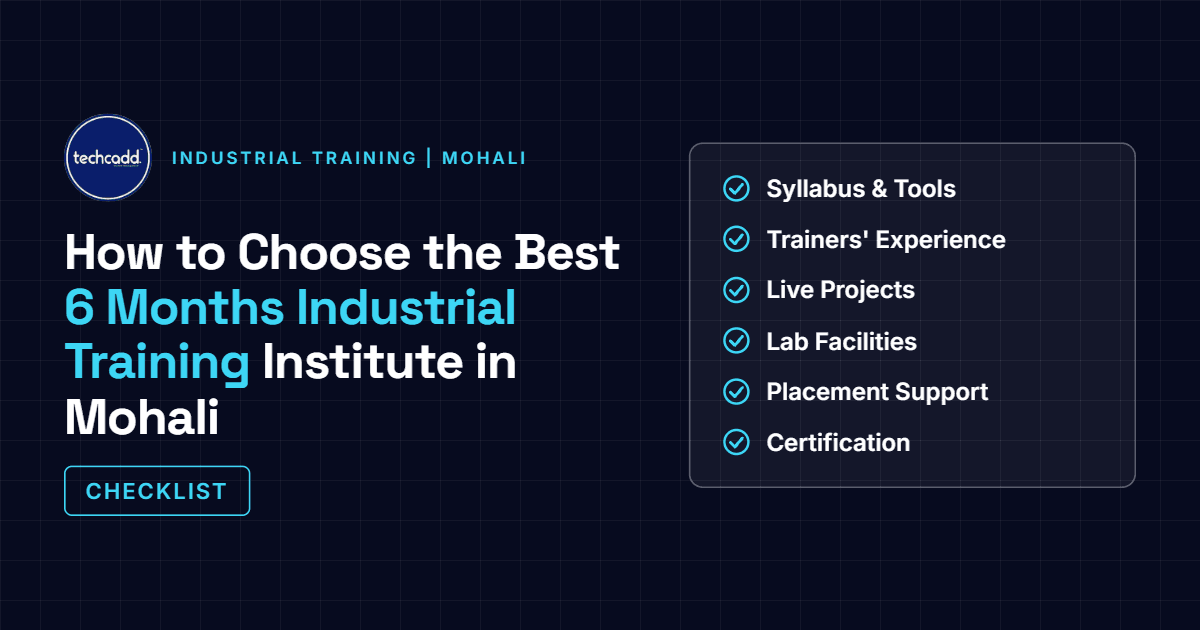
How to Choose the Best 6 Months Industrial Training Institute in Mohali (Checklist)
Choosing the right institute for six months of industrial training is an important decision for engineering, diploma and computer application students. The quality of training can influence your technical knowledge, practical experience, project portfolio and confidence during job interviews. With several training institutes offering different programs in Mohali, comparing them carefully before enrolling is essential.
A good institute should provide more than classroom lectures. It should help students understand industry tools, practise real-world tasks, complete projects and develop professional skills. This guide provides a practical checklist to help you select a suitable 6 months industrial training institute in Mohali.
1. Check Whether the Course Matches Your Career Goals
Start by identifying the technical field in which you want to build your career. Do not choose a course only because it is popular. Select a program that matches your academic background, interests and intended job role.
Full Stack Development: HTML, CSS, JavaScript, React, Node.js and databases.
Data Science: Python, statistics, Pandas, NumPy and machine learning fundamentals.
Digital Marketing: SEO, Google Ads, social media marketing and analytics.
Cyber Security: Networking, security fundamentals, ethical hacking concepts and VAPT basics.
Cloud Computing and DevOps: AWS, Azure, Git, Docker, CI/CD and deployment workflows.
CAD and Engineering Design: AutoCAD, Revit, SolidWorks and other relevant design tools.
Robotics and IoT: Microcontrollers, sensors, embedded systems and automation fundamentals.
Ask the institute for a detailed syllabus and confirm that it covers the skills required for your chosen career path.
2. Evaluate the Course Curriculum and Learning Structure
A structured six-month course should have a clear learning sequence. The curriculum should begin with fundamentals and gradually introduce intermediate and advanced concepts.
Check the following before admission:
Is the syllabus updated according to current industry practices?
Does it include practical exercises after theoretical lessons?
Are multiple tools and technologies covered where relevant?
Are assignments and assessments included?
Does the program include a final project?
Is there a clear month-wise training plan?
Request a copy of the syllabus instead of relying only on verbal descriptions. A transparent curriculum makes it easier to understand what you will learn during the program.
3. Verify the Experience and Teaching Approach of Trainers
Trainers play a major role in your learning experience. A knowledgeable trainer should be able to explain technical concepts, demonstrate practical workflows and help students solve problems independently.
Ask whether the trainers have relevant technical or industry experience. You can also request a demo class to understand their teaching approach.
Look for trainers who:
Explain concepts with practical examples.
Provide guidance during assignments and projects.
Encourage questions and independent problem-solving.
Share relevant tools, resources and learning practices.
Give constructive feedback on student performance.
4. Give Priority to Hands-On Practical Training
One of the most important factors in industrial training is practical exposure. Students should spend sufficient time working with the tools and technologies mentioned in the syllabus.
For example, a web development student should build web pages and applications, while a CAD student should practise creating and editing engineering drawings. A data analytics student should work with datasets and dashboards.
Ask the institute these questions:
How many practical sessions are conducted each week?
Will students work individually or only observe demonstrations?
Are assignments based on real-world scenarios?
Will students get access to required software and lab facilities?
5. Review the Live Projects and Portfolio Opportunities
Projects help students apply their knowledge and demonstrate their abilities to potential employers. A good six-month training program should include practical projects relevant to the selected specialization.
Examples include:
Full Stack Development: E-commerce website, student management system or booking application.
Data Science: Sales prediction, customer segmentation or data analysis dashboard.
Digital Marketing: SEO audit, keyword research report and sample advertising campaign.
Cyber Security: Network security assessment in an authorized lab and vulnerability documentation.
Cloud and DevOps: Cloud deployment, automated build pipeline and containerized application.
CAD Design: Mechanical components, building plans or engineering drawings.
Confirm whether you will personally contribute to projects and whether you can document your work in a portfolio. Do not assume that a project certificate automatically proves practical experience.
6. Inspect Infrastructure, Labs and Software Availability
Before joining, visit the training centre if possible. Check whether the classrooms, computer systems, internet connectivity and software facilities are suitable for your course.
Use this infrastructure checklist:
Functional computers or workstations.
Required licensed or appropriate software access.
Reliable internet connectivity.
Comfortable classroom and lab environment.
Availability of practical equipment for hardware-based courses.
Access to learning resources and project support.
7. Understand Placement and Career Support
Career guidance can help students prepare for opportunities after training. However, placement support and guaranteed employment are not the same thing. Ask the institute to explain exactly what assistance it provides.
Useful career support may include:
Resume preparation and review.
Technical interview practice.
Mock interviews and aptitude guidance.
Communication and professional skills development.
Information about relevant job openings.
Interview referrals where available.
If placement statistics are shared, ask how they are calculated, what period they cover and whether the figures can be independently verified.
8. Check Student Reviews and Previous Work
Student feedback can provide useful information about teaching quality, practical sessions, trainer support and the overall learning environment. Read reviews from multiple sources rather than depending on a single testimonial.
Also ask to see examples of previous student projects, subject to privacy and permission. If possible, speak with former students about their experience.
9. Compare Fees, Duration and Additional Costs
Training fees should be compared alongside the quality and scope of the program. The lowest fee is not necessarily the best value, and a higher fee does not automatically mean better training.
Before paying, confirm:
Total course fees and payment schedule.
What is included in the fee.
Whether software, lab or examination charges are additional.
Certificate and project documentation charges, if any.
Batch timings and attendance requirements.
Refund, cancellation and batch-transfer policies.
10. Verify Certification and Course Documentation
Ask what certificate or completion document is provided after training. Understand who issues it and what it confirms. A training certificate can document course completion, but it should not be treated as a substitute for demonstrable technical skills or recognized professional certification.
Keep copies of your syllabus, fee receipt, attendance record and project documentation.
Complete Checklist Before Joining a 6 Months Industrial Training Institute
Checklist ItemWhat to VerifyDone
Course selectionMatches your career goals☐
CurriculumDetailed and updated syllabus☐
TrainersRelevant knowledge and teaching experience☐
Practical sessionsRegular hands-on learning☐
ProjectsIndividual project and portfolio opportunities☐
InfrastructureSuitable labs, systems and software☐
Career supportClearly explained placement assistance☐
Student reviewsFeedback from multiple sources☐
FeesWritten fee structure and policies☐
CertificationClear certificate and completion details☐
Why Consider TechCADD Mohali for Industrial Training?
Students exploring industrial training options in Mohali can evaluate TechCADD alongside other institutes using the same checklist. Before enrolling, ask for the current course syllabus, trainer details, practical training structure, project examples, fee information and career-support policies.
Whether you are interested in software development, data science, digital marketing, cyber security, cloud computing, CAD design or emerging technologies, choose a program that offers structured learning and meaningful practical experience.
Suggested Six-Month Industrial Training Roadmap
Month 1: Learn fundamentals, tools and basic concepts.
Month 2: Practise core technologies through guided assignments.
Month 3: Work on intermediate exercises and small projects.
Month 4: Develop a specialization-based practical project.
Month 5: Build a larger project, improve documentation and fix errors.
Month 6: Complete the final project, prepare your portfolio and practise interviews.
Frequently Asked Questions
1. Why should students choose six months of industrial training?
A six-month program can provide more time for structured learning, regular practice, project development and career preparation than a shorter course, depending on its curriculum and delivery.
2. Who can join six months of industrial training in Mohali?
Eligibility depends on the program. BTech, diploma, BCA, MCA and other students may find suitable options in fields such as IT, engineering design, digital marketing and emerging technologies.
3. What should I check before paying the training fees?
Review the syllabus, trainer experience, practical sessions, project structure, infrastructure, total fees, certificate details and written policies.
4. Does industrial training guarantee a job?
No. Training can improve practical knowledge and interview readiness, but employment depends on skills, performance, vacancies and employer requirements.
5. Is a live project important during industrial training?
Yes. A meaningful project gives students an opportunity to apply concepts, solve problems and demonstrate their work through a portfolio or project presentation.
Conclusion
Choosing the best 6 months industrial training institute in Mohali requires careful research rather than relying only on advertisements or fee offers. Compare the curriculum, trainers, practical exposure, projects, infrastructure, career support, student feedback and certification details before making a decision.
Use the checklist in this guide when visiting institutes and asking questions. The right training program should help you build relevant technical skills, complete practical work and become better prepared for your next academic or professional step.
Want this mapped to your own background and goals?
Talk to a counsellorMore on the blog
How to Prepare a Project Report & Viva for 6 Months College Industrial Training
Learn how to prepare a professional project report and confidently face your viva after six months of college industrial training. Explore report structure, documentation tips, project presentation, common viva questions and preparation strategies.
Top 9 High-Paying Tech & Engineering Courses for 6 Months Internship in 2026
Explore 9 high-paying technology and engineering courses for a six-month internship in 2026. Compare essential skills, tools, practical projects and career opportunities to choose the right training path.

Comments
No comments yet — yours would be the first.