


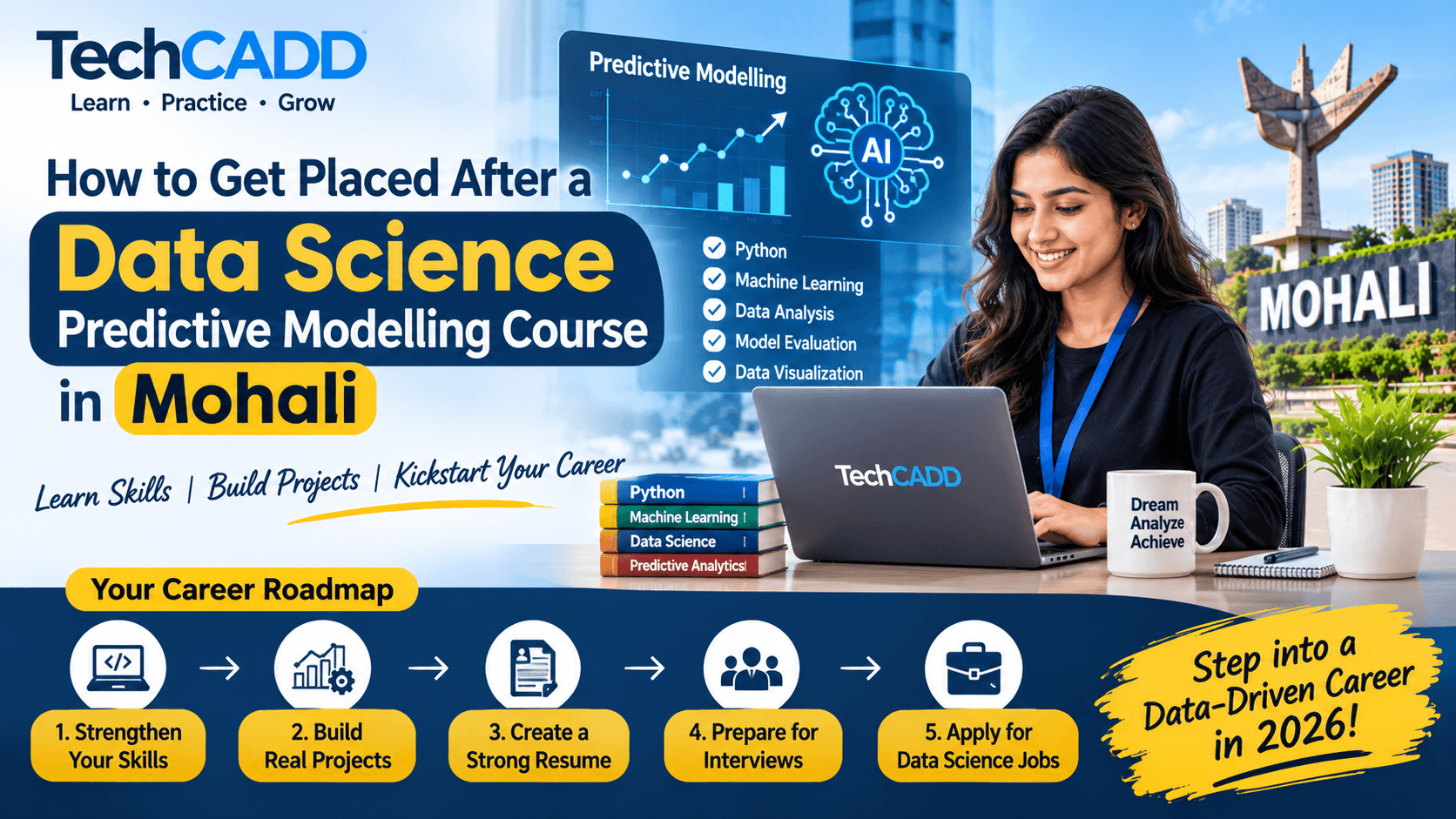
How to Get Placed After a Data Science Predictive Modelling Course in Mohali
Data Science has become an important part of modern business decision-making. Companies use data to understand customer behaviour, identify patterns, forecast future trends, improve operations, and make informed decisions. One of the most valuable techniques in this field is Predictive Modelling, which uses historical data, statistical methods, and machine learning algorithms to estimate future outcomes.
As businesses increasingly depend on data-driven strategies, learners with practical skills in Python, statistics, machine learning, SQL, and data visualization can explore career opportunities in the analytics and technology sectors.
However, completing a Data Science Predictive Modelling course is only the first step. Getting placed requires technical knowledge, practical project experience, a strong resume, interview preparation, and an understanding of what employers expect.
In this guide, we explain how to prepare for data science jobs after completing a predictive modelling course in Mohali, which skills to develop, which projects to build, and how to approach the placement process.
What Is Predictive Modelling in Data Science?
Predictive modelling is a data science technique used to estimate future events or outcomes by analysing historical and current data. It involves preparing datasets, identifying useful variables, selecting suitable algorithms, training models, and evaluating their performance.
For example, businesses can use predictive models to estimate product demand, identify customers who may leave a service, forecast sales, assess credit risk, or predict equipment maintenance requirements.
Predictive modelling commonly uses statistical methods and machine learning algorithms such as:
Linear regression and logistic regression.
Decision trees and random forests.
Classification algorithms.
Clustering techniques.
Gradient boosting methods.
Time-series forecasting techniques.
Learning these concepts helps students understand how data can be converted into useful business predictions.
Why Choose a Data Science Career in 2026?
Organizations across different industries collect large amounts of information through websites, applications, customer transactions, operations, and connected devices. They need professionals who can organize this information, analyse it, and communicate meaningful findings.
Data Science skills are relevant in several areas:
Banking and Finance: Risk analysis, fraud detection, and financial forecasting.
Healthcare: Analysing patient data, supporting research, and forecasting healthcare requirements.
E-commerce: Customer segmentation, demand prediction, and recommendation systems.
Retail: Sales forecasting, inventory planning, and customer behaviour analysis.
Manufacturing: Predictive maintenance, quality analysis, and production planning.
Telecommunications: Customer churn prediction and service performance analysis.
Marketing: Campaign performance analysis and customer targeting.
Essential Skills You Need to Get Placed After a Predictive Modelling Course
Employers generally look for a combination of technical knowledge, analytical thinking, communication skills, and practical experience. Focus on developing the following skills during and after your course.
1. Python Programming
Python is widely used in Data Science because it offers libraries for data cleaning, analysis, visualization, and machine learning.
Important concepts to practise include:
Variables, data types, loops, and conditional statements.
Functions and object-oriented programming basics.
NumPy for numerical computing.
Pandas for data manipulation and analysis.
Matplotlib and Seaborn for data visualization.
Working with CSV, Excel, and other data formats.
Try solving small programming problems regularly instead of only memorizing Python syntax.
2. Statistics and Probability
Statistics helps data science professionals understand datasets, identify relationships, and evaluate the reliability of results.
Focus on:
Mean, median, and mode.
Variance and standard deviation.
Probability distributions.
Correlation and covariance.
Hypothesis testing.
Confidence intervals and sampling.
These concepts are especially useful when selecting variables, interpreting model results, and explaining predictions.
3. Exploratory Data Analysis
Exploratory Data Analysis (EDA) is the process of examining a dataset before building a predictive model. It helps identify missing values, unusual observations, data quality issues, and patterns.
Learn how to:
Inspect and understand datasets.
Identify missing and duplicate records.
Detect outliers.
Study relationships between variables.
Create charts and summary statistics.
Prepare clean data for machine learning.
4. Machine Learning Algorithms
Machine learning is a core part of predictive modelling. You should understand how different algorithms work and when they are appropriate.
Linear and logistic regression.
Decision trees.
Random forests.
K-Nearest Neighbours.
Support Vector Machines.
K-Means clustering.
Gradient boosting and XGBoost fundamentals.
Do not focus only on running algorithms through code. Understand their assumptions, strengths, limitations, and suitable use cases.
5. Model Evaluation and Optimization
A predictive model should be evaluated before it is used to support decisions. Understanding evaluation metrics helps you determine whether a model performs reliably on unseen data.
Important concepts include:
Training, validation, and test datasets.
Cross-validation.
Accuracy, precision, recall, and F1-score.
Confusion matrix.
Mean Absolute Error and Root Mean Squared Error.
Overfitting and underfitting.
Hyperparameter tuning.
6. SQL and Database Skills
Data professionals often work with information stored in relational databases. SQL helps retrieve, filter, combine, and summarize data.
Practise SELECT statements, WHERE conditions, GROUP BY, ORDER BY, JOIN operations, subqueries, and aggregate functions.
7. Data Visualization with Tableau and Power BI
Technical analysis becomes more useful when results can be communicated clearly. Tableau and Power BI help create dashboards and reports that allow teams to understand business performance.
Learn to create charts, interactive dashboards, filters, calculated measures, and reports. Practise explaining what the visualizations reveal rather than simply displaying charts.
How to Build a Portfolio That Attracts Employers
A practical portfolio helps demonstrate what you can do with the skills learned during your course. Employers can review your projects to understand your approach to data preparation, modelling, evaluation, and communication.
Try building projects such as the following:
1. House Price Prediction
Build a regression model that estimates property prices using features such as location, property size, number of rooms, and other relevant factors.
Skills demonstrated: data cleaning, exploratory analysis, regression, feature selection, and model evaluation.
2. Customer Churn Prediction
Develop a classification model that identifies customers who may stop using a service based on historical customer information.
Skills demonstrated: classification, feature engineering, imbalanced data handling, and precision-recall evaluation.
3. Sales Forecasting
Analyse historical sales information and develop a model to estimate future demand or revenue.
Skills demonstrated: time-based analysis, data visualization, forecasting, and business interpretation.
4. Loan Approval Prediction
Build a model that analyses applicant information and predicts loan approval outcomes using a suitable classification approach.
Skills demonstrated: data preprocessing, classification, model evaluation, and responsible interpretation of predictions.
5. Customer Segmentation
Use clustering techniques to group customers according to purchasing patterns or other relevant characteristics.
Skills demonstrated: exploratory analysis, clustering, feature scaling, and visualization.
6. End-to-End Data Science Capstone Project
Choose a practical business problem and complete the entire workflow, from collecting or selecting data to presenting the final results.
Your project should explain:
The problem you are trying to solve.
The dataset and its source.
Data cleaning and preparation steps.
Exploratory data analysis.
Model selection and training.
Evaluation metrics and results.
Limitations and possible improvements.
Business insights and recommendations.
Step-by-Step Placement Roadmap After a Data Science Course
Follow a structured approach to move from course completion to job applications. The timeline below is a suggested preparation plan, not a guaranteed placement schedule.
Step 1: Strengthen Your Fundamentals
Suggested timeline: Weeks 1–2
Revise Python programming and Pandas.
Practise statistics and probability questions.
Understand common machine learning algorithms.
Revise SQL queries and database concepts.
Review model evaluation techniques.
Step 2: Complete Practical Projects
Suggested timeline: Weeks 3–5
Complete at least two or three well-documented projects.
Use real-world or publicly available datasets.
Explain the complete modelling process.
Compare model performance using suitable metrics.
Document your work on GitHub.
Step 3: Create a Professional Resume
Suggested timeline: Week 6
Your resume should clearly communicate your technical abilities and project experience. Keep it easy to read and relevant to the job description.
Include:
Education and relevant training.
Python, SQL, statistics, and machine learning skills.
Tools such as Pandas, Scikit-learn, Tableau, and Power BI.
Two or three relevant projects.
GitHub and portfolio links.
Internship or work experience, if applicable.
Describe projects using action-oriented statements. For example, explain which dataset you used, which model you developed, and how you evaluated its performance.
Step 4: Prepare for Technical Interviews
Suggested timeline: Weeks 7–8
Technical interviews may include questions about Python, SQL, statistics, machine learning, and your project experience.
Prepare for questions such as:
What is the difference between supervised and unsupervised learning?
What is the difference between regression and classification?
What is overfitting, and how can it be reduced?
What is the purpose of cross-validation?
How do you handle missing values?
What is the difference between precision and recall?
How do SQL joins work?
How did you select and evaluate the model in your project?
Step 5: Improve Your Communication Skills
Data science professionals need to explain technical findings to people who may not have a programming background.
Practise explaining projects in simple language.
Describe the business problem behind each model.
Explain why you selected a particular algorithm.
Discuss model limitations honestly.
Practise presenting dashboards and analytical findings.
Step 6: Apply for Relevant Entry-Level Roles
Start applying for roles that match your current skills and experience. Read job descriptions carefully and customize your resume for relevant requirements.
Possible entry-level roles include:
Junior Data Analyst.
Data Science Intern.
Junior Data Scientist.
Machine Learning Intern.
Business Intelligence Analyst.
Reporting Analyst.
Junior Machine Learning Engineer.
Job titles and requirements vary between employers. Some positions may require additional experience, advanced programming, or specialized domain knowledge.
How to Find Data Science Job Opportunities in Mohali
Mohali and the wider Chandigarh region have technology companies, IT service providers, startups, and businesses that use analytics and software solutions. Candidates can explore local and remote opportunities through multiple channels.
Job portals: Search for Data Analyst, Junior Data Scientist, and Machine Learning Intern roles.
LinkedIn: Follow companies, connect with recruiters, and share project updates.
Company career pages: Check openings directly on employer websites.
Networking: Attend technology events, workshops, and professional meetups.
Internships: Apply for relevant internships to gain practical workplace experience.
Project portfolio: Share GitHub repositories and project demonstrations with recruiters.
Common Mistakes to Avoid During Placement Preparation
Many learners understand the course material but struggle to demonstrate their skills during interviews. Avoid these common mistakes:
Learning algorithms without understanding their practical applications.
Copying projects without understanding the code.
Ignoring SQL and statistics fundamentals.
Adding skills to a resume without practical knowledge.
Failing to explain model evaluation results.
Applying to roles without checking their requirements.
Ignoring communication and presentation skills.
Expecting a job offer only because a course has been completed.
Why Consider TechCADD Mohali for Data Science Training?
Choosing the right training environment can help learners develop the technical foundation and practical experience required for data-related careers.
TechCADD Mohali lists a six-month Data Science programme covering Python, statistics, machine learning, SQL, Tableau, and Power BI. Its published curriculum also includes regression, classification, clustering, advanced machine learning topics, model evaluation, and a capstone project.
The institute's course information describes practical learning, project work, resume preparation, interview preparation, and placement assistance. These services can support a learner's preparation, but placement assistance should not be interpreted as a guarantee of employment.
Before enrolling, students should review the current syllabus and confirm the following details with the institute:
Whether predictive modelling is covered in sufficient practical depth.
Which machine learning algorithms and tools are included.
What projects are completed during the programme.
Whether students receive feedback on their project work.
What resume and interview preparation services are available.
How placement assistance works and which roles are targeted.
Current course duration, schedule, and fees.
Final Checklist Before Applying for Data Science Jobs
Understand Python and Pandas fundamentals.
Practise statistics and exploratory data analysis.
Understand regression, classification, and clustering.
Know how to evaluate predictive models.
Practise SQL queries and data extraction.
Build dashboards using Tableau or Power BI.
Complete and document practical projects.
Prepare a clear, job-focused resume.
Practise technical and HR interview questions.
Apply consistently to suitable opportunities.
Frequently Asked Questions (FAQs)
1. How can I get a job after a Data Science Predictive Modelling course in Mohali?
Strengthen your Python, SQL, statistics, and machine learning skills. Build practical predictive modelling projects, prepare a professional resume, practise technical interviews, and apply for relevant entry-level jobs and internships.
2. Is predictive modelling important for a Data Scientist?
Yes. Predictive modelling is an important part of data science. It helps professionals use historical information and machine learning techniques to estimate future outcomes and support business decisions.
3. Which programming language should I learn for Data Science?
Python is a popular choice because it offers libraries such as NumPy, Pandas, Matplotlib, and Scikit-learn. SQL is also important for working with structured databases.
4. Which projects should I include in my Data Science resume?
Consider including house price prediction, customer churn prediction, sales forecasting, loan approval prediction, and customer segmentation. Explain the dataset, methodology, algorithms, and evaluation results for each project.
5. Can freshers apply for Data Science jobs?
Yes. Freshers can explore internships and suitable entry-level positions such as junior data analyst, data science intern, and reporting analyst. Requirements differ across companies, so a practical portfolio can help demonstrate your abilities.
6. Does TechCADD Mohali provide placement assistance for Data Science students?
TechCADD Mohali's published Data Science course information describes placement assistance, resume building, and interview preparation. Students should contact the institute to confirm the current support process and terms.
7. How long does it take to prepare for a Data Science job?
The preparation period depends on your previous knowledge, practice time, and project experience. A structured plan can help you revise fundamentals, build a portfolio, and prepare for interviews, but getting hired depends on several factors.
Conclusion
Getting placed after a Data Science Predictive Modelling course requires more than completing the syllabus. You need to understand Python, statistics, SQL, machine learning algorithms, and model evaluation while gaining experience through practical projects.
Build a portfolio that demonstrates your ability to solve real problems, prepare a focused resume, practise technical interviews, and apply consistently for relevant roles. If you are planning to begin or strengthen your Data Science journey, explore the training options at TechCADD Mohali and confirm the current curriculum and placement assistance details before enrolling.
With consistent learning, practical experience, and focused preparation, you can work towards building a career in Data Science and predictive analytics.
Want this mapped to your own background and goals?
Talk to a counsellorMore on the blog
Why Cybersecurity & VAPT Skills Are in High Demand Across Indian IT Hubs in 2026
Discover why cybersecurity and VAPT skills are increasingly important across Indian IT hubs in 2026. Explore industry demand, essential tools, career opportunities, practical projects and the skills aspiring security professionals need to build a career.
Red Team vs Blue Team vs SOC Analyst: Cybersecurity Job Roles Explained
Understand the differences between Red Team, Blue Team and SOC Analyst roles in cybersecurity. Explore their responsibilities, skills, tools, certifications, practical projects, career paths and how beginners can choose the right cybersecurity specialisation.

Comments
No comments yet — yours would be the first.