


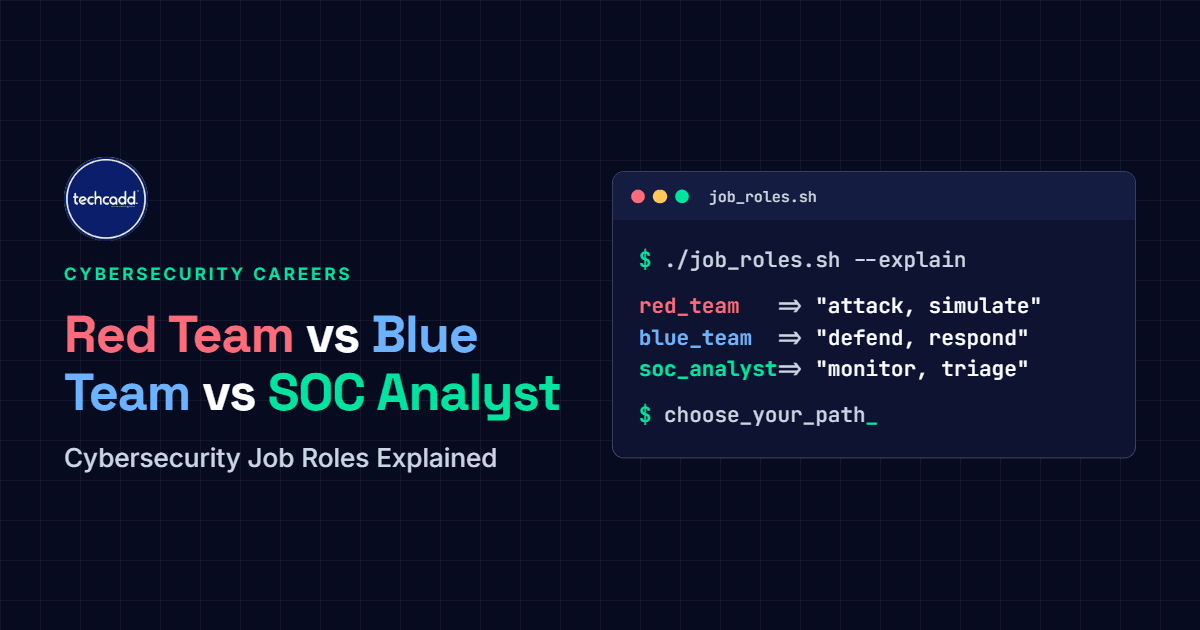
Red Team vs Blue Team vs SOC Analyst: Cybersecurity Job Roles Explained
Cybersecurity has become a critical requirement for organisations that depend on digital platforms, cloud infrastructure, networks and online applications. As cyber threats become more sophisticated, businesses need professionals who can test security, defend systems and continuously monitor suspicious activities.
Three important roles in this field are Red Team professionals, Blue Team professionals and Security Operations Centre (SOC) Analysts. Although these roles share the same goal of improving security, their responsibilities, working methods and daily activities are different.
For students, freshers and IT professionals planning to enter cybersecurity, understanding these job roles can make career planning easier. This guide explains how Red Teams, Blue Teams and SOC Analysts work, which skills they need, the tools they use and how beginners can prepare for these opportunities.
1. What Is a Red Team in Cybersecurity?
A Red Team performs authorised security assessments by simulating selected attacker techniques to evaluate an organisation's security controls. Its purpose is to identify weaknesses, test detection capabilities and help organisations understand how their systems might be targeted.
Red Team professionals work within an approved scope and follow defined rules of engagement. Their assessments may include applications, networks, cloud environments, identity systems and security processes.
Key responsibilities of a Red Team professional
Understanding the authorised assessment scope and objectives.
Performing information gathering and security reconnaissance.
Identifying potential vulnerabilities in permitted environments.
Conducting controlled security testing.
Evaluating security controls and possible attack paths.
Documenting findings, impact and remediation recommendations.
Communicating assessment results to security teams.
Important Red Team skills
Networking fundamentals and TCP/IP concepts.
Linux and Windows operating system knowledge.
Python and scripting fundamentals.
Web application security.
Vulnerability assessment and penetration testing concepts.
Understanding identity, authentication and access control.
Technical report writing and communication.
Common tools used by Red Teams
Kali Linux: A security-focused Linux environment.
Nmap: Network discovery and service assessment.
Burp Suite: Web application security testing.
Metasploit Framework: Controlled vulnerability validation.
Wireshark: Network traffic analysis.
BloodHound: Analysis of Active Directory relationships and permissions in authorised environments.
Example project: Conduct an authorised assessment of an intentionally vulnerable virtual machine, document identified weaknesses and recommend appropriate fixes.
2. What Is a Blue Team in Cybersecurity?
A Blue Team focuses on protecting an organisation's systems, networks, applications and information. It works to prevent attacks, identify suspicious behaviour, strengthen security controls and support incident response.
While Red Teams simulate attacker behaviour during authorised assessments, Blue Teams concentrate on defence, monitoring, detection and recovery.
Key responsibilities of a Blue Team professional
Monitoring networks, endpoints and infrastructure.
Configuring and maintaining security controls.
Reviewing security logs and suspicious events.
Supporting vulnerability management activities.
Strengthening access controls and system configurations.
Investigating security incidents.
Supporting incident containment and recovery.
Improving security policies and operational procedures.
Important Blue Team skills
Network security and firewall fundamentals.
Windows and Linux administration.
Log analysis and event investigation.
Endpoint protection and security monitoring.
Incident response fundamentals.
Identity and access management.
Threat detection and security documentation.
Common Blue Team tools
Microsoft Defender: Endpoint and security protection capabilities.
Splunk: Security data analysis and monitoring workflows.
Wazuh: Open-source security monitoring and threat detection.
Suricata: Network threat detection and traffic inspection.
Snort: Network intrusion detection and prevention capabilities.
Security Onion: A platform for network security monitoring and analysis.
Example project: Set up a small security monitoring lab, collect sample system logs and create alerts for selected suspicious activities.
3. What Is a SOC Analyst?
A Security Operations Centre Analyst, commonly called a SOC Analyst, monitors an organisation's IT environment to identify, investigate and respond to potential security incidents.
SOC teams use monitoring platforms, security alerts, logs and investigation procedures to understand suspicious activities. SOC Analysts often work as part of a larger security operations team.
Key responsibilities of a SOC Analyst
Monitoring security dashboards and alerts.
Reviewing logs from endpoints, servers and network devices.
Investigating suspicious login attempts and unusual activities.
Correlating information from different security sources.
Prioritising alerts based on severity and potential impact.
Escalating confirmed or high-risk incidents.
Maintaining incident records and investigation reports.
Supporting security incident response procedures.
Important SOC Analyst skills
Networking and operating system fundamentals.
Understanding common cyber threats and attack techniques.
SIEM platform knowledge.
Log analysis and event correlation.
Incident triage and investigation.
Basic scripting and query skills.
Clear communication and documentation.
Common tools used by SOC Analysts
Splunk: Searching, analysing and visualising security data.
Microsoft Sentinel: Cloud-based security information and event management.
Wazuh: Security monitoring and log analysis.
Microsoft Defender: Endpoint threat detection and investigation.
Wireshark: Investigating network traffic.
TheHive: Supporting security incident case management.
Example project: Analyse a sample authentication log dataset, identify unusual login patterns and prepare an incident investigation report.
4. Red Team vs Blue Team vs SOC Analyst: Key Differences
All three roles contribute to an organisation's security, but they approach the problem from different perspectives.
ComparisonRed TeamBlue TeamSOC Analyst
Main focusAuthorised attack simulationSecurity defenceSecurity monitoring and investigation
Primary objectiveFind and validate weaknessesPrevent and respond to threatsDetect and investigate alerts
Typical activitySecurity assessmentsDefensive operationsAlert triage and analysis
Important skillsTesting and vulnerability analysisDefence and incident responseLog analysis and investigation
Common toolsNmap, Burp Suite, MetasploitWazuh, Defender, SuricataSplunk, Sentinel, Wireshark
Typical outputAssessment reportImproved security controlsIncident and alert reports
5. How Red Teams and Blue Teams Work Together
Red and Blue Teams are not competitors within an organisation. Their activities can complement each other and improve overall security.
Planning: The organisation defines assessment objectives, scope and permissions.
Testing: The Red Team performs controlled security assessments.
Detection: The Blue Team monitors systems and evaluates whether relevant activities are detected.
Investigation: SOC Analysts review alerts, correlate evidence and escalate incidents.
Reporting: Teams document findings, detection gaps and defensive weaknesses.
Improvement: The organisation strengthens security controls and updates response procedures.
This collaboration is also related to Purple Teaming, an approach that encourages Red and Blue Teams to share knowledge and improve detection and defence capabilities.
6. Which Cybersecurity Role Is Best for Freshers?
The best starting role depends on your technical interests, existing knowledge and preferred work style.
Choose Red Team if you enjoy:
Exploring how applications and networks work.
Learning penetration testing methodologies.
Finding and documenting security weaknesses.
Working on authorised technical assessments.
Understanding attacker techniques from a security perspective.
Choose Blue Team if you enjoy:
Protecting systems and networks.
Improving security configurations.
Investigating security events.
Working with defensive tools and controls.
Supporting incident response and threat prevention.
Choose SOC Analyst if you enjoy:
Monitoring security alerts and dashboards.
Investigating suspicious events.
Analysing logs and network information.
Following structured investigation procedures.
Working in a security operations environment.
For many beginners, SOC Analyst or junior security operations roles can be useful entry points, depending on their education, skills and employer requirements. Red Team roles often require a stronger foundation in networking, systems and security testing.
7. Essential Skills to Learn Before Applying for Cybersecurity Jobs
Regardless of the specialisation, students should build a strong technical foundation before moving into advanced cybersecurity topics.
Networking Fundamentals
Understand IP addresses, TCP/IP, DNS, ports, routing, firewalls and common network protocols.
Operating Systems
Learn Linux commands, Windows administration, file permissions, services, users and event logs.
Programming and Scripting
Start with Python and learn basic scripting concepts. Familiarity with PowerShell or Bash can also support security tasks.
Cybersecurity Fundamentals
Understand malware, phishing, vulnerabilities, authentication, encryption, access control and security policies.
SIEM and Log Analysis
Learn how security information and event management platforms collect, search and correlate information from different systems.
Communication and Reporting
Develop the ability to explain technical findings, document investigations and recommend practical security improvements.
8. Certifications for Red Team, Blue Team and SOC Careers
Certifications can help learners organise their preparation and demonstrate knowledge. They should be selected according to experience level, career goals and current exam requirements.
CertificationRelevant learning area
CompTIA Network+Networking fundamentals
CompTIA Security+Foundational cybersecurity
Certified Ethical Hacker (CEH)Ethical hacking concepts
eJPTPractical entry-level penetration testing
CompTIA CySA+Security analysis and threat detection
Blue Team Level 1 (BTL1)Defensive security and incident response
OSCPAdvanced practical penetration testing
Beginners should first focus on fundamentals and practical labs. Advanced certifications are more suitable after developing the required technical knowledge.
9. Practical Cybersecurity Projects for Students
Practical projects help freshers demonstrate skills during interviews. Use only systems you own, isolated labs or environments where you have explicit permission to perform security testing.
Project 1: Network Discovery Lab
Use Nmap on a small private virtual network to identify authorised hosts and services. Document your observations and suggest security improvements.
Project 2: Security Log Analysis
Review sample authentication logs to identify repeated failed logins, unusual access times and other suspicious patterns.
Project 3: SIEM Monitoring Dashboard
Use a training dataset in a SIEM platform to build a basic dashboard showing event counts, login activity and selected security alerts.
Project 4: Web Application Security Assessment
Use an intentionally vulnerable practice application to study common web security issues and document remediation recommendations.
Project 5: Incident Response Documentation
Prepare a simulated incident report describing the event, evidence, severity, investigation steps and recommended response.
Project 6: Endpoint Monitoring Lab
Configure a personal lab to collect sample endpoint events and examine how monitoring tools identify suspicious behaviour.
10. Six-Month Cybersecurity Career Learning Roadmap
Month 1: Networking and Computer Fundamentals
Understand computer systems and operating systems.
Study TCP/IP, DNS, ports and network protocols.
Learn basic troubleshooting and network concepts.
Month 2: Linux, Windows and Programming
Practise Linux commands and permissions.
Understand Windows users, services and event logs.
Learn Python basics and simple scripting.
Month 3: Cybersecurity Fundamentals
Study threats, vulnerabilities and security controls.
Understand authentication and access management.
Explore basic network security and web security concepts.
Month 4: Specialisation Introduction
Explore authorised penetration testing concepts.
Learn defensive monitoring and log analysis.
Understand SIEM platforms and security alerts.
Month 5: Practical Projects
Complete guided Red Team and Blue Team exercises.
Practise SOC alert investigation with sample data.
Prepare project reports and remediation recommendations.
Month 6: Portfolio and Placement Preparation
Choose a preferred cybersecurity career direction.
Prepare a resume and project portfolio.
Revise technical fundamentals and practise interviews.
Explore suitable entry-level certifications.
This roadmap provides a suggested structure, not a guarantee of job readiness or placement. Students should continue practising and developing their skills after completing the programme.
11. Career Opportunities in Cybersecurity
Depending on qualifications and practical experience, learners can explore different entry-level and specialised roles.
SOC Analyst L1
Junior Security Analyst
Security Operations Associate
Vulnerability Assessment Associate
Junior Penetration Tester
Network Security Associate
Incident Response Associate
Information Security Analyst
Role responsibilities and eligibility vary between employers. Some positions may require a relevant degree, certifications, shift availability or prior practical experience.
12. How Practical Cybersecurity Training Helps
Cybersecurity training should combine technical concepts with guided practice. Students benefit from learning how to use tools, interpret results, document findings and understand security remediation.
When comparing cybersecurity training programmes in Mohali, consider the following:
Coverage of networking, Linux and Windows fundamentals.
Practical labs for both offensive and defensive security.
Exposure to SIEM tools and log analysis.
Guided projects and technical report writing.
Trainer experience and lab support.
Interview preparation and portfolio guidance.
Clear rules for safe and authorised security testing.
A useful training programme should help students understand the concepts behind tools instead of focusing only on memorising commands.
13. Common Mistakes Beginners Should Avoid
Trying advanced penetration testing before understanding networking.
Learning tools without understanding the security concepts behind them.
Ignoring defensive security and focusing only on ethical hacking.
Using security tools on systems without permission.
Listing certifications or tools on a resume without practical knowledge.
Ignoring documentation, communication and problem-solving skills.
Expecting a short course to replace continuous practice.
Frequently Asked Questions (FAQs)
1. What is the main difference between Red Team and Blue Team?
Red Teams conduct authorised assessments to simulate attacker techniques and identify weaknesses. Blue Teams focus on defending systems, detecting threats and improving security controls.
2. Is a SOC Analyst part of the Blue Team?
Yes. SOC Analysts commonly perform defensive security monitoring, alert triage and investigation as part of security operations.
3. Which role is best for cybersecurity freshers?
There is no single best role for everyone. SOC Analyst and junior security operations positions may be suitable starting points for learners who enjoy monitoring and investigation. Students interested in penetration testing can build towards junior Red Team roles.
4. Do Red Team professionals need programming skills?
Basic programming and scripting are valuable for automation and understanding applications. Python is a useful starting point.
5. What tools should a SOC Analyst learn?
Beginners can explore SIEM platforms such as Splunk and Microsoft Sentinel, along with log analysis, Wireshark, endpoint monitoring and incident documentation.
6. Can I learn Red Team and Blue Team skills in six months?
A six-month programme can introduce core concepts and provide guided practice in both areas. Professional expertise requires continued learning and practical experience.
7. Is a cybersecurity certification necessary for a SOC Analyst job?
Certification requirements vary by employer. Foundational certifications can help demonstrate knowledge, but practical skills, communication and technical understanding are also important.
Conclusion
Red Team, Blue Team and SOC Analyst roles represent different but closely connected areas of cybersecurity. Red Teams evaluate security through authorised attack simulations, Blue Teams strengthen defence and incident response, while SOC Analysts monitor systems and investigate potential threats.
For students and freshers, the best way to enter cybersecurity is to build strong networking, Linux, Windows and security fundamentals before choosing a specialisation. Practical labs, meaningful projects, tool familiarity and clear technical documentation can help create a strong foundation for future opportunities.
Whether you want to explore ethical hacking, defensive security or security operations, consistent learning and responsible practice are essential for developing a sustainable cybersecurity career.
Want this mapped to your own background and goals?
Talk to a counsellorMore on the blog
How to Prepare a Project Report & Viva for 6 Months College Industrial Training
Learn how to prepare a professional project report and confidently face your viva after six months of college industrial training. Explore report structure, documentation tips, project presentation, common viva questions and preparation strategies.
Top 9 High-Paying Tech & Engineering Courses for 6 Months Internship in 2026
Explore 9 high-paying technology and engineering courses for a six-month internship in 2026. Compare essential skills, tools, practical projects and career opportunities to choose the right training path.

Comments
No comments yet — yours would be the first.