


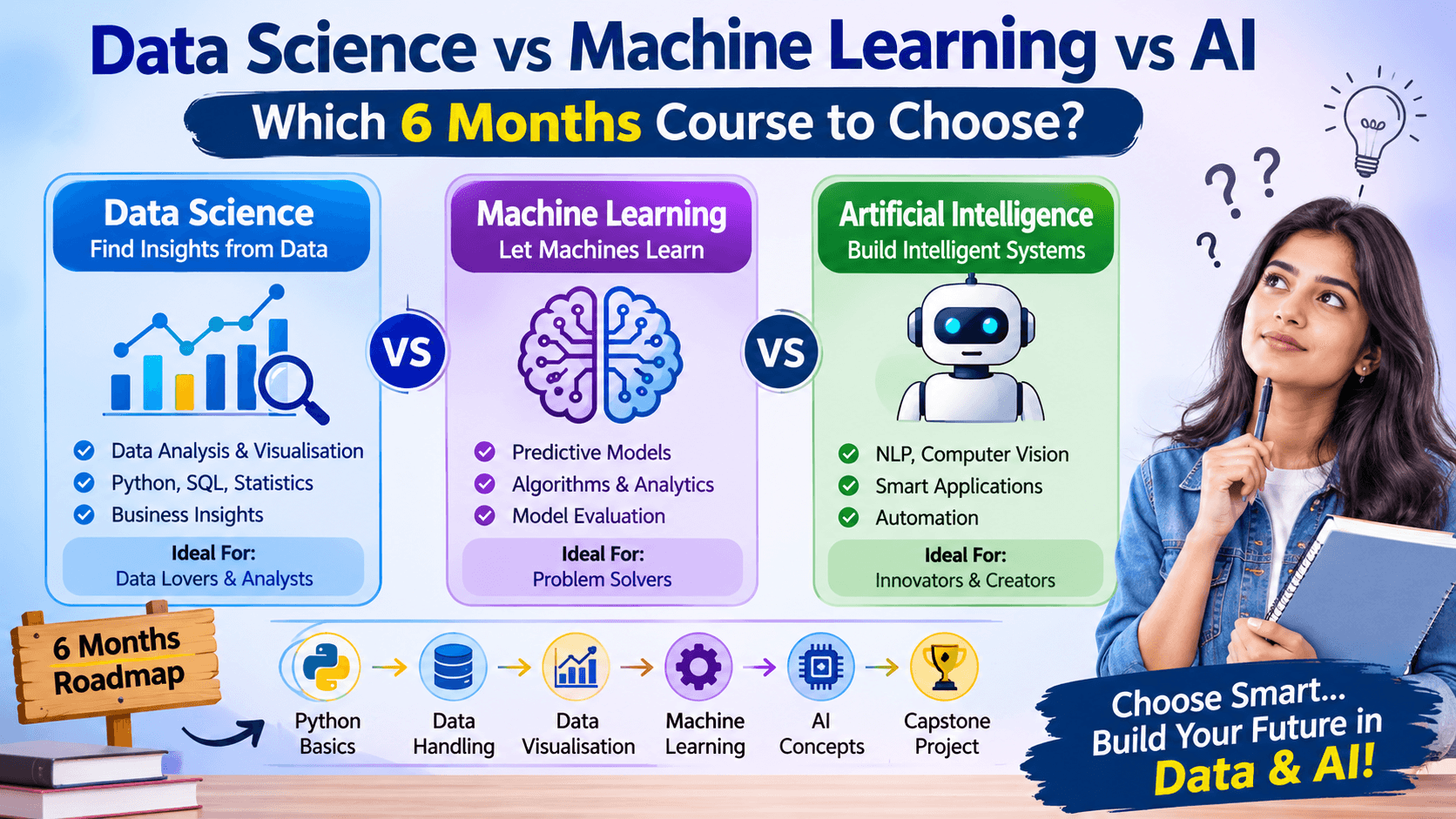
Data Science vs Machine Learning vs AI: Which 6 Months Course to Choose?
Technology is changing how businesses operate, make decisions and solve problems. Data Science, Machine Learning (ML) and Artificial Intelligence (AI) are three important fields driving this transformation. Students, graduates and working professionals often find it difficult to decide which one to learn first.
If you are planning to join a six-month technical training programme, understanding the differences between these fields can help you select a course that matches your interests, current skills and career goals. This guide compares Data Science, Machine Learning and AI, explains the tools involved and presents a practical six-month learning roadmap.
1. What Is Data Science?
Data Science is a field that uses statistics, programming, data analysis and visualisation to extract meaningful information from structured and unstructured data. Organisations use data science to understand customer behaviour, monitor performance, identify trends and support business decisions.
Skills You Learn in Data Science
Python programming fundamentals
Statistics and probability
Data cleaning and preprocessing
NumPy and Pandas
SQL and database fundamentals
Data visualisation using Matplotlib, Seaborn or Power BI
Exploratory data analysis
Introduction to machine learning
Practical Data Science Projects
Student performance analysis
Sales and business performance dashboard
Customer segmentation analysis
Exploratory analysis of public datasets
House price data analysis
Data Science can be a suitable starting point for learners who enjoy working with information, identifying patterns and explaining insights through data.
2. What Is Machine Learning?
Machine Learning is a branch of Artificial Intelligence that enables computer systems to learn patterns from data and make predictions or decisions without requiring every rule to be programmed manually.
Machine learning is used in recommendation engines, fraud detection, demand forecasting, spam filtering and predictive maintenance.
Skills You Learn in Machine Learning
Python programming
Statistics and linear algebra basics
Data preparation and feature engineering
Supervised and unsupervised learning
Regression and classification
Clustering techniques
Model evaluation and validation
Scikit-learn and introductory model deployment
Practical Machine Learning Projects
House price prediction
Email spam classification
Customer churn prediction
Product recommendation system
Credit risk classification using sample datasets
Machine Learning may suit learners who enjoy mathematics, programming, experimentation and building predictive models.
3. What Is Artificial Intelligence?
Artificial Intelligence is a broad area of computer science focused on building systems that perform tasks commonly associated with human intelligence. These tasks can include understanding language, recognising images, reasoning, planning and generating content.
Machine Learning is one approach used to develop AI systems. Other areas include knowledge representation, search, reasoning, natural language processing, computer vision and generative AI.
Skills You Learn in AI
Python programming
AI fundamentals and problem-solving
Search and reasoning concepts
Machine learning fundamentals
Natural Language Processing basics
Computer vision fundamentals
Introduction to neural networks and deep learning
Responsible and ethical AI practices
Practical AI Projects
Basic chatbot using an AI API
Image classification demonstration
Text sentiment analysis
Document question-answering prototype
Simple voice or text assistant
AI can be a good choice for learners interested in building intelligent applications and exploring technologies such as chatbots, language models and computer vision.
4. Data Science vs Machine Learning vs AI: Key Differences
AreaData ScienceMachine LearningArtificial Intelligence
Main focusExtracting insights from dataLearning patterns and making predictionsBuilding systems that perform intelligent tasks
Core skillsStatistics, analysis and visualisationAlgorithms, modelling and evaluationReasoning, ML, NLP and computer vision
Common toolsPython, SQL, Pandas, Power BIPython, Scikit-learn, TensorFlowPython, PyTorch, TensorFlow and AI APIs
Example projectSales analytics dashboardCustomer churn predictionAI-powered chatbot
Typical objectiveUnderstand what the data showsPredict or classify using dataAutomate or assist intelligent tasks
These fields overlap. Data Science can use Machine Learning, while Machine Learning is an important part of many AI applications. The right learning path depends on the type of problems you want to solve.
5. Which Six-Month Course Should You Choose?
Choose Data Science If:
You enjoy analysing information and finding trends.
You want to learn Python, SQL and data visualisation.
You are interested in business intelligence and analytics.
You prefer building dashboards and data-driven reports.
Choose Machine Learning If:
You enjoy mathematics, statistics and programming.
You want to build predictive models.
You are interested in recommendation systems and forecasting.
You already have or are ready to develop basic Python and statistics skills.
Choose Artificial Intelligence If:
You want to explore intelligent applications and automation.
You are interested in chatbots, NLP or computer vision.
You want to understand how machine learning powers AI products.
You are comfortable learning programming and technical concepts.
Beginner recommendation: If you are unsure, a structured Data Science foundation can be a practical starting point. It introduces Python, statistics, data handling and visualisation before progressing towards Machine Learning and selected AI topics. However, learners with a clear interest in intelligent applications may prefer an AI-focused pathway.
6. Suggested Six-Month Learning Roadmap
Month 1: Programming and Foundations
Learn Python syntax, variables, data types and functions.
Practise conditions, loops, lists and dictionaries.
Understand basic mathematics, statistics and probability.
Complete small Python programming exercises.
Month 2: Data Handling and Analysis
Learn NumPy and Pandas.
Work with CSV and spreadsheet datasets.
Practise data cleaning and preprocessing.
Use SQL for basic data queries.
Month 3: Visualisation and Data Science Projects
Explore Matplotlib and Seaborn.
Build charts and dashboards.
Perform exploratory data analysis.
Complete a sales or student performance analysis project.
Month 4: Machine Learning Fundamentals
Understand supervised and unsupervised learning.
Practise regression and classification.
Explore clustering algorithms.
Learn model evaluation and avoid data leakage.
Build a basic prediction project.
Month 5: AI and Advanced Topics
Understand AI, neural networks and deep learning basics.
Explore introductory NLP or computer vision.
Learn how AI APIs can be used in applications.
Discuss responsible AI, privacy and model limitations.
Month 6: Capstone Project and Career Preparation
Choose a project based on your preferred specialisation.
Clean data, build and evaluate your solution.
Document the project and upload suitable code to GitHub.
Prepare a portfolio and project presentation.
Practise technical interview questions and explain your work.
This is a suggested learning sequence, not a guarantee that every advanced topic can be mastered in six months. Your progress will depend on your starting level, practice time, course depth and project work.
7. Career Opportunities After These Courses
Each field offers different entry-level and long-term career possibilities. Actual eligibility depends on your educational background, technical skills, portfolio and employer requirements.
Possible Data Science Roles
Junior Data Analyst
Data Science Trainee
Business Intelligence Analyst
Reporting Analyst
Junior Data Scientist, where qualifications match
Possible Machine Learning Roles
Machine Learning Intern
Junior Machine Learning Engineer
Data Analyst with ML skills
AI/ML Project Trainee
Junior Predictive Analytics Associate
Possible AI Roles
AI Application Developer Trainee
AI/ML Intern
Junior NLP Developer
Computer Vision Trainee
AI Solutions Support Associate
Some specialised engineering roles require stronger mathematics, software development experience, advanced study or a relevant degree. A six-month course should be viewed as a foundation for skill development rather than a guarantee of employment.
8. Why Practical Training and Projects Matter
Watching tutorials alone is not enough to develop job-ready skills. A good training programme should combine concepts with coding exercises, real datasets, mentor feedback and complete projects.
When comparing training institutes in Mohali, consider whether the programme provides:
A clearly defined syllabus and realistic six-month schedule.
Hands-on Python and database practice.
Training with relevant data and AI tools.
Individual and team-based project opportunities.
Guidance on GitHub, documentation and portfolios.
Technical interview and presentation practice.
Transparent information about fees, batches and course support.
At TechCadd Mohali, prospective students can enquire about available Data Science, Machine Learning and Artificial Intelligence training options, practical learning activities and current batch details before selecting a programme.
9. Common Mistakes to Avoid When Choosing a Course
Choosing only by popularity: Select a subject based on your interests and learning goals, not just trends.
Ignoring prerequisites: Check the required programming, mathematics and statistics foundations.
Focusing only on certificates: Practical skills and demonstrable projects are important.
Expecting instant expertise: Six months can build a foundation, but advanced skills require continued practice.
Not checking the syllabus: Compare actual modules, tools, projects and trainer support before enrolling.
10. Frequently Asked Questions
Q1. Which is better for beginners: Data Science, Machine Learning or AI?
Data Science is often a practical starting point because it introduces Python, statistics and data handling. However, the best choice depends on your interests and existing knowledge.
Q2. Can I learn Data Science in six months?
You can build a foundation in Python, statistics, data analysis, visualisation and introductory machine learning in six months with consistent practice. Becoming an expert generally requires more time and experience.
Q3. Is Machine Learning part of Artificial Intelligence?
Yes. Machine Learning is a major subfield of AI that allows systems to learn patterns from data. AI also includes other approaches such as reasoning, planning and knowledge representation.
Q4. Do I need coding skills before joining an AI or Data Science course?
Not always. Many beginner programmes start with Python fundamentals. Basic mathematics and a willingness to practise programming can be helpful.
Q5. Which course has better career opportunities?
All three fields offer opportunities, but job requirements vary by role and organisation. Compare the skills you enjoy developing with the qualifications requested in relevant job descriptions.
Q6. Can BTech, BCA and other graduates learn these subjects?
Yes. Students and graduates from different academic backgrounds can explore these fields. The appropriate starting level depends on their programming and mathematics experience.
Conclusion
Data Science, Machine Learning and Artificial Intelligence are connected fields, but they focus on different challenges. Data Science helps you understand data, Machine Learning builds models that learn from patterns, and AI develops systems capable of performing intelligent tasks.
If you are a beginner choosing a six-month course, start by identifying your interests, reviewing the syllabus and checking the practical projects included. A strong foundation, consistent coding practice and a portfolio of meaningful projects can help you prepare for further learning and future career opportunities.
Explore relevant training options at TechCadd Mohali and compare the course structure, practical exposure and support before making your decision.
Want this mapped to your own background and goals?
Talk to a counsellorMore on the blog
Why Cybersecurity & VAPT Skills Are in High Demand Across Indian IT Hubs in 2026
Discover why cybersecurity and VAPT skills are increasingly important across Indian IT hubs in 2026. Explore industry demand, essential tools, career opportunities, practical projects and the skills aspiring security professionals need to build a career.
Red Team vs Blue Team vs SOC Analyst: Cybersecurity Job Roles Explained
Understand the differences between Red Team, Blue Team and SOC Analyst roles in cybersecurity. Explore their responsibilities, skills, tools, certifications, practical projects, career paths and how beginners can choose the right cybersecurity specialisation.

Comments
No comments yet — yours would be the first.