


Introduction
Modern websites and web applications require more than attractive designs and interactive user interfaces. Behind every successful application is a backend system that manages data, processes requests, handles authentication, and connects different application components. This is why backend development has become an important skill for aspiring web developers.
The MERN Stack is a popular technology combination used to build modern web applications. It includes MongoDB, Express.js, React.js, and Node.js. While React.js focuses on the frontend, Node.js and Express.js provide the tools required to develop server-side functionality and APIs.
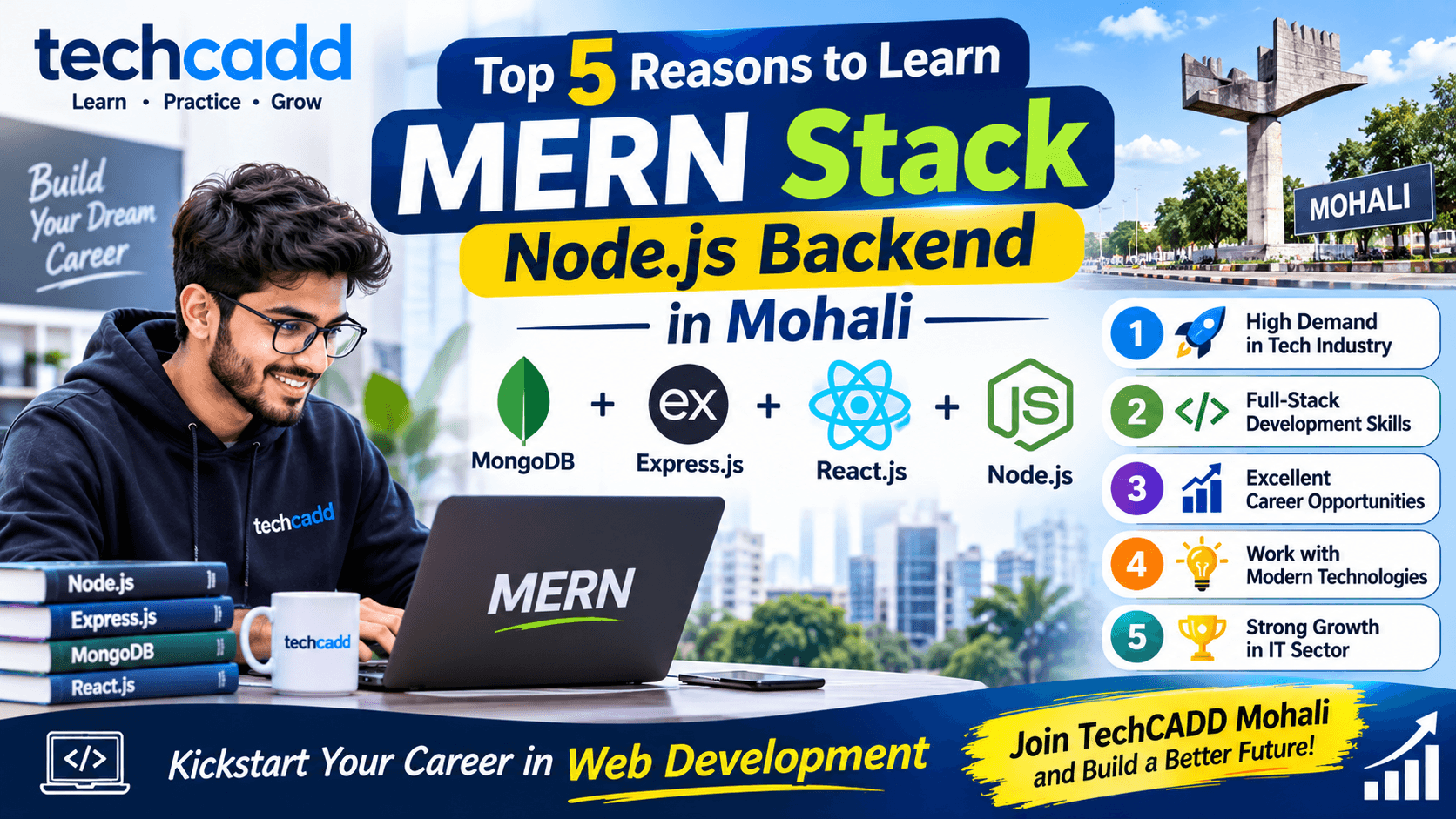
If you are planning to build a career in web development, learning MERN Stack Node.js Backend in Mohali can be a useful step. In this article, we explore five reasons to learn this technology, the skills you can develop, practical projects, and career opportunities.
What Is MERN Stack Node.js Backend Development?
MERN is an acronym for four technologies that work together to develop full-stack web applications:
MongoDB: A document-oriented database used to store and manage application data.
Express.js: A backend web framework for Node.js that helps developers build routes, APIs, and server-side application logic.
React.js: A JavaScript library used to build interactive user interfaces.
Node.js: A JavaScript runtime environment that allows developers to execute JavaScript outside the browser, including on servers.
In backend development, Node.js and Express.js are especially important. They help developers handle client requests, connect databases, implement authentication, validate information, and create REST APIs that frontend applications can use.
Top 5 Reasons to Learn MERN Stack Node.js Backend in Mohali
1. Build Complete Backend Development Skills
One major reason to learn Node.js backend development is that it helps you understand how web applications work behind the scenes. A professional backend handles information exchange between the user interface, server, and database.
With Node.js and Express.js, learners can practise:
Creating server-side applications.
Building RESTful APIs.
Handling HTTP requests and responses.
Managing routes and middleware.
Implementing user authentication.
Connecting applications with databases.
Handling errors and validating user input.
These skills provide a foundation for developing applications that do more than display static information.
2. Work with a JavaScript-Based Technology Stack
JavaScript is used across different parts of the MERN Stack. React.js is used for frontend development, while Node.js allows JavaScript to run on the server. Express.js simplifies backend application development.
Learning this combination can help developers work across frontend and backend components without switching between completely different programming languages for the application logic.
For learners who already know JavaScript, Node.js can be a natural next step towards understanding server-side programming.
3. Develop Real-World Applications and APIs
Practical application development is one of the most valuable parts of learning backend technologies. Node.js and Express.js allow developers to create APIs that support real application requirements.
For example, an e-commerce application may require backend functionality for:
User registration and login.
Product information and inventory.
Shopping cart management.
Order processing.
Payment gateway integration.
Admin dashboards.
Building these features helps learners understand how different application components communicate with each other. It also provides practical examples that can be included in a development portfolio.
4. Understand Database Integration with MongoDB
Applications need databases to store user information, product details, transactions, and other records. MongoDB is a document database commonly used in MERN Stack applications.
During backend training, learners can understand how to:
Connect Node.js applications with MongoDB.
Create and manage collections.
Insert, retrieve, update, and delete records.
Work with documents and queries.
Use Mongoose for object data modelling.
Design database structures for application requirements.
Understanding database integration is important because backend developers frequently work with data storage and retrieval operations.
5. Explore Multiple Career Opportunities
Learning MERN Stack Node.js backend technologies can support several web development career paths. Organizations across industries require developers who can build, maintain, and improve web applications.
Depending on your overall skills and experience, you can explore opportunities such as:
Node.js Backend Developer.
MERN Stack Developer.
Junior Backend Developer.
Full Stack Web Developer.
API Developer.
Web Application Developer.
Career progression depends on your practical knowledge, problem-solving ability, project experience, and understanding of software development practices.
Important Topics to Learn in a MERN Stack Node.js Backend Course
A structured backend development programme should cover programming fundamentals, server development, database integration, API development, security, and practical projects.
Module 1: JavaScript Fundamentals
Variables and data types.
Functions and scope.
Arrays and objects.
Loops and conditional statements.
ES6+ features.
Arrow functions and destructuring.
Promises and asynchronous JavaScript.
Async and await.
Module 2: Introduction to Node.js
Understanding Node.js architecture.
Installing and configuring Node.js.
Working with the Node.js runtime.
Modules and package management.
File system operations.
Events and event-driven programming.
Understanding asynchronous operations.
Module 3: Express.js Backend Development
Introduction to Express.js.
Creating Express servers.
Routing and route parameters.
Request and response handling.
Middleware functions.
Error handling.
Handling form and JSON data.
Module 4: MongoDB Database Integration
Introduction to MongoDB.
Databases and collections.
Documents and data types.
CRUD operations.
Database connections.
Mongoose schemas and models.
Data validation and relationships.
Module 5: REST API Development
Understanding REST architecture.
HTTP methods and status codes.
GET, POST, PUT, PATCH, and DELETE requests.
Creating API endpoints.
Request validation.
API testing using Postman.
API error handling and response structures.
Module 6: Authentication and Security
User registration and login systems.
Password hashing.
Authentication using JSON Web Tokens.
Authorization and protected routes.
Environment variables.
Input validation and secure API practices.
Module 7: Practical Projects and Deployment
Building complete backend applications.
Connecting frontend applications with APIs.
Testing application functionality.
Using Git and GitHub.
Understanding deployment fundamentals.
Debugging and maintaining applications.
Practical Projects to Build During Node.js Backend Training
Working on projects helps learners apply programming concepts to practical development problems. Here are some useful projects for building a backend development portfolio.
1. User Authentication System
Create a registration and login system using Node.js, Express.js, and MongoDB. Include password hashing, input validation, and protected routes.
2. E-Commerce Backend
Build backend functionality for an online shopping application. Include product management, user accounts, cart operations, and order handling.
3. Blog Management API
Develop an API that allows users to create, edit, retrieve, and delete blog posts. Add authentication and role-based permissions.
4. Student Management System
Create an application that stores student records, course details, attendance information, and other academic data.
5. Task Management Application
Develop a backend system that allows users to create tasks, update their status, set deadlines, and organize work efficiently.
For each project, document the application requirements, API endpoints, database structure, authentication approach, and testing process. This makes your portfolio more useful when discussing your work during interviews.
Career Scope After Learning MERN Stack Node.js Backend
Node.js backend skills can be useful in companies developing websites, SaaS platforms, e-commerce systems, business applications, and digital products.
Node.js Backend Developer
Backend developers create server-side application logic, manage databases, develop APIs, and maintain application functionality.
MERN Stack Developer
MERN Stack developers work with MongoDB, Express.js, React.js, and Node.js to develop full-stack web applications.
API Developer
API developers create and maintain interfaces that allow different software applications to exchange information.
Full Stack Developer
Full Stack developers work on both frontend and backend components. They may create user interfaces, develop APIs, connect databases, and manage application workflows.
Web Application Developer
Web application developers build and maintain browser-based software for business operations, customer services, and online platforms.
Industries That Use Node.js Backend Development
Node.js can be used in many types of web and software applications. Some examples include:
IT and software services: Business applications, APIs, and web platforms.
E-commerce: Shopping applications, product management, and order processing.
Fintech: Digital financial applications and service integrations.
Education technology: Learning platforms, student portals, and online assessment systems.
Healthcare technology: Appointment systems, patient portals, and administrative applications.
Startups: Rapid development of web products and application prototypes.
Why Learn MERN Stack Node.js Backend in Mohali?
Mohali is part of the wider Chandigarh Tricity region, where students and aspiring professionals can explore technical education and software development training options.
Choosing a local training programme can provide opportunities for structured learning, practical exercises, instructor guidance, and interaction with other learners.
When comparing a MERN Stack or Node.js backend course in Mohali, check whether the curriculum includes JavaScript fundamentals, Express.js, MongoDB, REST API development, authentication, Git, and practical application projects.
At TechCADD, learners can explore relevant web development training options and review the available course syllabus, training format, practical work, and support before choosing a programme.
How to Prepare for a Node.js Backend Developer Job
Learning a programming framework is only one part of becoming job-ready. Follow a structured approach to strengthen your development skills.
Strengthen JavaScript fundamentals: Understand functions, objects, arrays, ES6 features, promises, and asynchronous programming.
Learn Node.js and Express.js: Practise server creation, routing, middleware, and request handling.
Understand MongoDB: Work with database operations, schemas, models, and data validation.
Build REST APIs: Develop endpoints and test them using Postman.
Learn authentication: Practise secure login systems, password hashing, and protected routes.
Create portfolio projects: Build complete applications that demonstrate your backend skills.
Learn Git and GitHub: Maintain and present your source code professionally.
Prepare for interviews: Practise JavaScript concepts, Node.js questions, API scenarios, database queries, and project explanations.
Apply for suitable roles: Search for junior backend, Node.js, and MERN Stack development opportunities.
Common Mistakes to Avoid While Learning Node.js
Skipping JavaScript fundamentals and directly starting backend frameworks.
Memorizing commands without understanding how server-side applications work.
Ignoring asynchronous programming and error handling.
Learning MongoDB without understanding database design.
Creating APIs without validating user input.
Ignoring authentication and application security.
Completing tutorials without building independent projects.
Not using Git and GitHub to organize development work.
Expecting a job based only on completing a course.
Frequently Asked Questions (FAQs)
1. What is MERN Stack Node.js backend development?
It involves developing the server-side functionality of MERN applications using Node.js and Express.js, with MongoDB commonly used for database management.
2. Is Node.js good for beginners?
Yes. Beginners who understand basic JavaScript can start learning Node.js and gradually move towards server development, APIs, and database integration.
3. Do I need to learn React before Node.js?
No. You can learn Node.js backend development independently. However, understanding React can help you work on complete MERN Stack applications.
4. What is the role of Express.js in MERN Stack?
Express.js is a backend framework for Node.js. It simplifies routing, middleware management, request handling, and API development.
5. Is MongoDB necessary for MERN Stack development?
MongoDB is the database technology represented by the M in MERN. Understanding it is important when developing applications using the complete MERN Stack.
6. What projects should I build after learning Node.js?
You can build an authentication system, e-commerce backend, blog API, task management application, or student management system.
7. Can I become a full-stack developer after learning Node.js?
Node.js provides backend development skills. To work as a MERN Stack full-stack developer, you should also learn React.js, frontend development, and how to integrate frontend and backend systems.
8. What career opportunities are available after MERN Stack training?
Depending on your skills and experience, you can explore roles such as Node.js Backend Developer, MERN Stack Developer, API Developer, Web Application Developer, and Full Stack Developer.
Conclusion
Learning MERN Stack Node.js Backend can be a valuable step for students and aspiring developers interested in modern web application development. It provides practical knowledge of server-side programming, API creation, database integration, authentication, and application architecture.
The five reasons discussed in this article highlight how Node.js backend skills can support your technical growth and help you explore different web development career paths.
If you are looking for a MERN Stack Node.js Backend course in Mohali, compare the syllabus, practical projects, trainer guidance, and learning support before enrolling. Focus on developing strong JavaScript fundamentals and building real applications to demonstrate your abilities.
Want this mapped to your own background and goals?
Talk to a counsellorMore on the blog
How to Prepare a Project Report & Viva for 6 Months College Industrial Training
Learn how to prepare a professional project report and confidently face your viva after six months of college industrial training. Explore report structure, documentation tips, project presentation, common viva questions and preparation strategies.
Top 9 High-Paying Tech & Engineering Courses for 6 Months Internship in 2026
Explore 9 high-paying technology and engineering courses for a six-month internship in 2026. Compare essential skills, tools, practical projects and career opportunities to choose the right training path.

Comments
No comments yet — yours would be the first.