


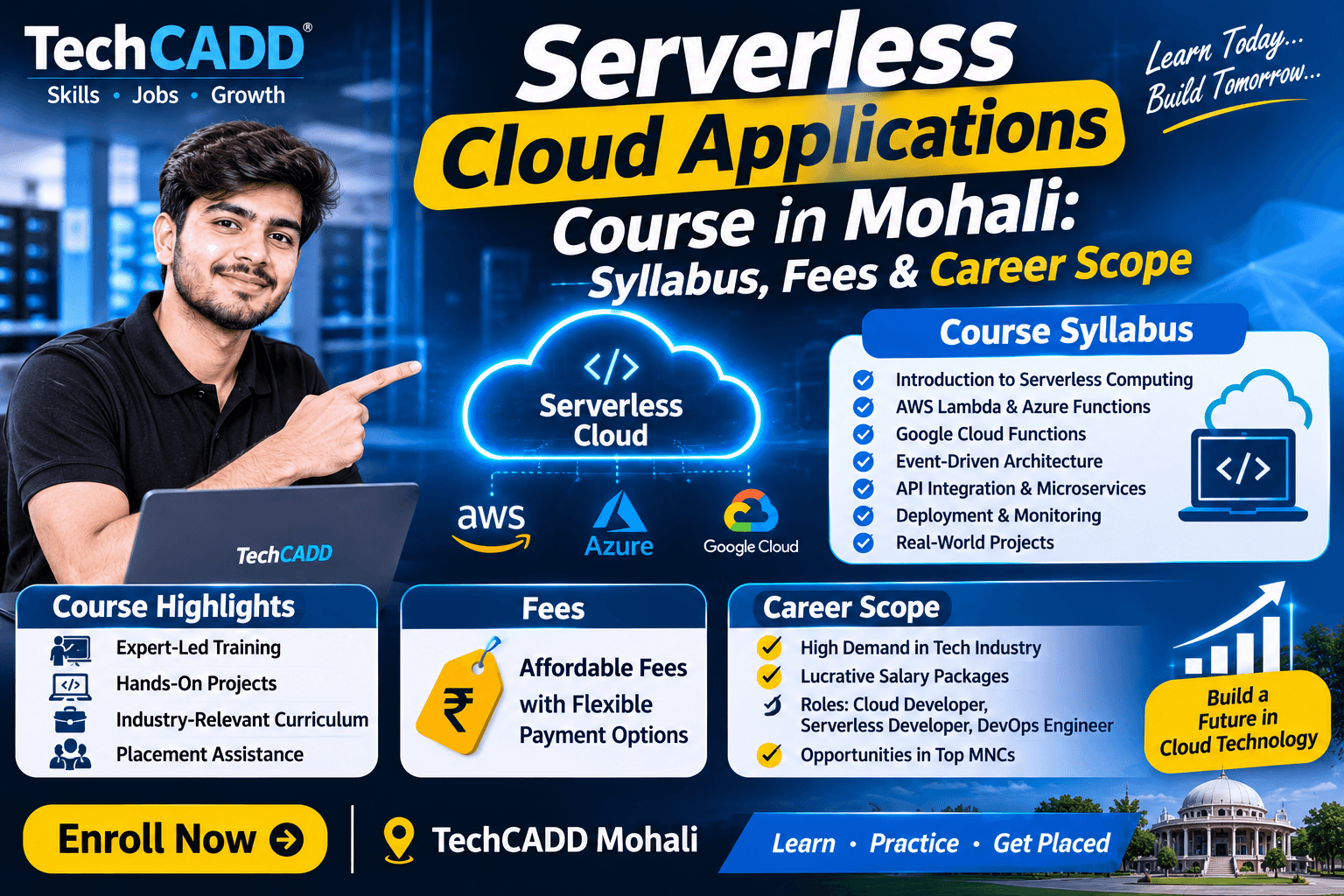
Introduction to Serverless Cloud Applications
Cloud computing has transformed how businesses develop, deploy and manage software applications. One of the important developments in this field is serverless computing. It allows developers to build and run applications without directly managing the underlying server infrastructure. Cloud providers take responsibility for infrastructure provisioning, scaling and much of the operational management.
A Serverless Cloud Applications Course in Mohali can help students and working professionals understand this modern approach to application development. Through concepts, platform-based exercises and practical projects, learners can explore how serverless applications are designed, deployed and maintained.
What Is Serverless Computing?
Serverless computing is a cloud execution model in which the cloud provider manages the servers and infrastructure required to run application code. Developers focus primarily on application logic, while the provider handles tasks such as resource allocation and scaling.
Serverless does not mean that applications run without servers. It means developers do not need to manage those servers directly. Many serverless services use an event-driven model, where a function runs in response to an event such as an HTTP request, file upload, database update or scheduled trigger.
Why Learn Serverless Cloud Application Development?
Reduced infrastructure management: Focus on writing and maintaining application code rather than managing server hardware and operating systems.
Automatic scaling: Supported services can scale execution based on incoming events and workload.
Event-driven development: Build applications that respond to events from APIs, storage services, queues and databases.
Cloud integration: Connect functions with databases, authentication, storage and monitoring services.
Flexible cost models: Many services charge based on requests, execution time or resource consumption, subject to provider-specific pricing and limits.
Modern development skills: Understand concepts used in cloud-native and distributed application architectures.
Serverless Cloud Applications Course Syllabus
Module 1: Cloud Computing Fundamentals
Introduction to cloud computing and its service models
Public, private and hybrid cloud concepts
Cloud regions, availability zones and basic infrastructure
Virtual machines, containers and serverless computing
Introduction to cloud security and shared responsibility
Module 2: Serverless Architecture Fundamentals
Meaning and characteristics of serverless architecture
Function as a Service (FaaS)
Backend as a Service (BaaS)
Event-driven architecture and event triggers
Stateless functions and execution environments
Serverless use cases, benefits and limitations
Module 3: AWS Serverless Services
Introduction to Amazon Web Services
AWS Lambda functions and execution roles
Amazon API Gateway fundamentals
Amazon S3 event notifications
Amazon DynamoDB integration
Amazon EventBridge and event-driven workflows
CloudWatch logs and monitoring basics
Module 4: Microsoft Azure Serverless Services
Introduction to Microsoft Azure
Azure Functions and function triggers
HTTP, timer and event-based triggers
Azure Storage integration
Azure Logic Apps fundamentals
Monitoring and troubleshooting with Azure tools
Module 5: Google Cloud Serverless Services
Introduction to Google Cloud Platform
Cloud Run fundamentals
Cloud Functions concepts and event-driven execution
Cloud Storage integration
Cloud Pub/Sub and event messaging
Application monitoring and logging
Module 6: APIs, Databases and Application Integration
REST API fundamentals
Connecting serverless functions to APIs
Working with SQL and NoSQL databases
Authentication and authorization basics
Environment variables and configuration
Error handling, retries and timeout management
Module 7: Security, Testing and Deployment
Identity and access management fundamentals
Least-privilege permissions
Secrets and sensitive configuration management
Function testing and debugging
Deployment workflows and version management
Logging, monitoring and performance optimization
Basic CI/CD concepts for cloud applications
Practical Projects You Can Build
Practical exercises help learners connect serverless concepts with real application requirements. Example projects may include:
Serverless REST API: Create an API using a cloud function, API gateway and database.
Image Processing Workflow: Trigger a function when a user uploads an image to cloud storage.
Automated Email Notification: Build an event-driven workflow that sends notifications when a specified event occurs.
Scheduled Data Processing: Run a cloud function on a schedule to process or summarize data.
File Upload Application: Create a simple application that stores uploaded files and records their metadata.
Who Can Enrol in This Course?
A serverless cloud applications course may be useful for:
Students interested in cloud computing and application development
Graduates from computer science and IT backgrounds
Software developers who want to explore cloud-native technologies
Backend developers interested in event-driven application design
IT professionals planning to expand their cloud skills
Beginners who have basic programming knowledge and want to learn cloud development
Basic knowledge of programming, APIs and databases can make the learning process easier. Beginners can first build familiarity with one programming language and fundamental web development concepts.
Serverless Cloud Applications Course Fees in Mohali
Course fees in Mohali can vary depending on the training institute, course duration, syllabus depth, practical lab access, project work, trainer experience and placement-support services. Advanced modules covering multiple cloud platforms may also affect the overall fee.
Before enrolling, ask the training provider for a detailed fee structure. Check whether the quoted amount includes practical sessions, study material, project guidance, assessment and any certification examination charges. Cloud-provider certification exams, where applicable, may have separate fees.
For accurate and current pricing, contact the institute directly and request a written breakdown of the course fee and included services.
Career Scope After Learning Serverless Computing
Serverless computing is used in cloud-based application development, automation, API backends, data processing and event-driven workflows. Learning these technologies can complement broader software development and cloud engineering skills.
Depending on your programming knowledge, cloud platform experience and project portfolio, possible roles to explore include:
Cloud Developer: Develop and integrate applications using cloud services.
Backend Developer: Build APIs, application logic and database integrations.
Cloud Application Developer: Design and deploy applications using managed cloud services.
Cloud Engineer: Work with cloud infrastructure, deployment and operational services.
DevOps Engineer: Support deployment automation, monitoring and application delivery workflows.
Cloud Solutions Associate: Assist with cloud application design and implementation.
Job titles and responsibilities differ between employers. Serverless training alone does not guarantee employment; practical experience, programming ability, cloud fundamentals and interview preparation remain important.
Skills That Can Improve Your Career Opportunities
Programming with Python, JavaScript, Java or another supported language
Understanding REST APIs and HTTP methods
Knowledge of SQL and NoSQL databases
Familiarity with AWS, Microsoft Azure or Google Cloud
Git and version-control workflows
Debugging, testing and application monitoring
Basic networking, security and access-management concepts
Deployment automation and CI/CD fundamentals
How to Choose a Serverless Cloud Applications Course in Mohali
Compare training options carefully before enrolling. Consider the following factors:
Updated syllabus: Confirm that the course covers current serverless concepts and relevant cloud services.
Hands-on practice: Look for guided labs using actual cloud platforms or suitable learning environments.
Project work: Ask whether you will build deployable applications and APIs.
Trainer experience: Understand the instructor's experience with cloud development.
Course transparency: Request clear details about duration, fees, prerequisites and learning outcomes.
Career guidance: Check what interview preparation, portfolio support or placement assistance is actually provided.
Why Learn Cloud Application Development in Mohali?
Mohali and the wider Chandigarh region offer learning and professional development opportunities in IT, software development and cloud technologies. A structured training programme can help learners build foundational knowledge, practise with cloud services and develop projects that demonstrate their skills.
When comparing institutes, focus on practical learning, trainer support, access to cloud labs and a syllabus that matches your career goals. Choose a programme that gives you enough time to understand the concepts and practise independently.
Frequently Asked Questions (FAQs)
1. What is a serverless cloud applications course?
It is a training programme that introduces serverless architecture, cloud functions, event-driven applications, APIs, databases, deployment and monitoring using cloud platforms.
2. Do I need programming knowledge to learn serverless computing?
Basic programming knowledge is helpful because serverless applications commonly use functions written in languages such as Python, JavaScript, Java and other supported languages.
3. Which cloud platforms offer serverless services?
AWS, Microsoft Azure and Google Cloud offer serverless services. Their tools and features differ, but they support application patterns such as event-driven execution and managed application hosting.
4. How long does it take to learn serverless application development?
The learning duration depends on your programming background, course structure, practical hours and the number of cloud platforms covered. Ask the institute for its detailed schedule.
5. What are the career opportunities after this course?
Learners may explore cloud developer, backend developer, cloud application developer and related roles. The opportunities available depend on practical skills, experience and employer requirements.
6. Does the course fee include cloud certification?
Not necessarily. Training fees and official cloud certification examination fees may be separate. Confirm the inclusions with the institute before enrolling.
Conclusion
Serverless computing is an important part of modern cloud application development. It helps developers create event-driven applications while relying on cloud providers to manage much of the underlying infrastructure. Learning AWS Lambda, Azure Functions, Google Cloud services, API integration, security and deployment can strengthen your cloud development foundation.
If you are considering a Serverless Cloud Applications Course in Mohali, compare the syllabus, practical projects, trainer experience and fee structure before making a decision. Consistent hands-on practice and a strong project portfolio can help you prepare for opportunities in cloud and software development.
Want this mapped to your own background and goals?
Talk to a counsellorMore on the blog
How to Prepare a Project Report & Viva for 6 Months College Industrial Training
Learn how to prepare a professional project report and confidently face your viva after six months of college industrial training. Explore report structure, documentation tips, project presentation, common viva questions and preparation strategies.
Top 9 High-Paying Tech & Engineering Courses for 6 Months Internship in 2026
Explore 9 high-paying technology and engineering courses for a six-month internship in 2026. Compare essential skills, tools, practical projects and career opportunities to choose the right training path.

Comments
No comments yet — yours would be the first.