


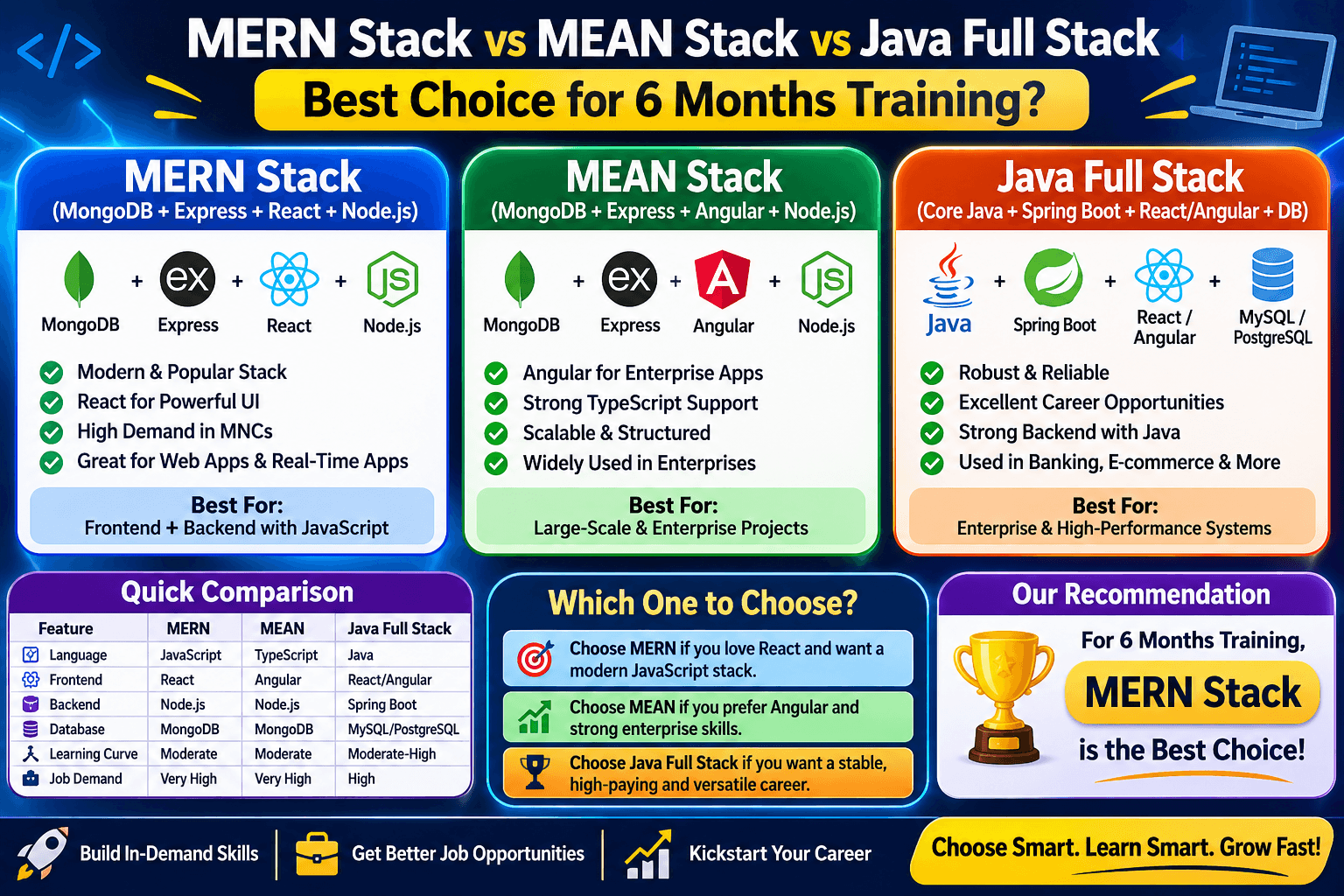
MERN Stack vs MEAN Stack vs Java Full Stack: Best Choice for 6 Months Training
Full stack development has become an important career option for students, graduates, and aspiring software developers. Businesses need professionals who can develop attractive frontend interfaces, manage backend applications, work with databases, and build complete web solutions.
Among the popular development paths, MERN Stack, MEAN Stack, and Java Full Stack are three widely discussed options. Each offers different technologies, development approaches, and career opportunities.
If you are planning to join a six-month full stack development training program, choosing the right technology can help you build practical skills and prepare for entry-level developer roles. This guide compares all three stacks to help you make an informed decision.
1. What Is MERN Stack Development?
MERN Stack is a JavaScript-based technology stack used to develop modern web applications. It combines four technologies that work together to build frontend interfaces, backend services, and database-driven applications.
Technologies Included in MERN Stack
MongoDB: A NoSQL database used to store application data.
Express.js: A backend framework for building APIs and server-side applications.
React.js: A JavaScript library used to develop interactive user interfaces.
Node.js: A JavaScript runtime used to execute backend applications.
What Can You Build with MERN Stack?
E-commerce websites.
Social networking applications.
Online booking platforms.
Task management systems.
Interactive business dashboards.
Career Opportunities
After developing MERN Stack skills, learners can explore opportunities such as Junior React Developer, Node.js Developer, MERN Stack Developer, and Junior Full Stack Developer.
2. What Is MEAN Stack Development?
MEAN Stack is another JavaScript-based development stack. It uses Angular instead of React for frontend development while maintaining MongoDB, Express.js, and Node.js for database and backend operations.
Technologies Included in MEAN Stack
MongoDB: Stores application data using a document-oriented database.
Express.js: Handles backend routing and API development.
Angular: A frontend framework for developing structured and scalable web applications.
Node.js: Provides the server-side JavaScript environment.
What Can You Build with MEAN Stack?
Enterprise web applications.
Customer management platforms.
Business administration portals.
Real-time applications.
Data management systems.
Career Opportunities
MEAN Stack learners can pursue roles such as Angular Developer, JavaScript Developer, Node.js Developer, and Full Stack Developer.
3. What Is Java Full Stack Development?
Java Full Stack Development involves building complete web applications using Java-based backend technologies and modern frontend tools. It is particularly useful for enterprise applications that require structured development, scalability, and long-term maintenance.
Technologies Included in Java Full Stack
HTML, CSS and JavaScript: Core frontend technologies.
React or Angular: Frontend frameworks or libraries used to build interactive interfaces.
Java: A programming language used for application development.
Spring Boot: A framework for developing Java backend applications and REST APIs.
Hibernate: An ORM framework for database operations.
MySQL or PostgreSQL: Relational database management systems.
What Can You Build with Java Full Stack?
Banking and financial applications.
Enterprise management systems.
Customer relationship management platforms.
Online shopping applications.
Business automation systems.
Career Opportunities
Java Full Stack training can prepare learners for opportunities such as Junior Java Developer, Spring Boot Developer, Backend Developer, and Full Stack Java Developer.
4. MERN vs MEAN vs Java Full Stack: Key Differences
Feature
MERN
MEAN
Java Full Stack
Frontend
React
Angular
React/Angular
Backend
Node.js and Express
Node.js and Express
Java and Spring Boot
Database
MongoDB
MongoDB
MySQL/PostgreSQL
Main Language
JavaScript
TypeScript/JavaScript
Java
Common Use
Modern web apps
Structured web apps
Enterprise applications
All three technology stacks can be used to develop full stack applications. The right choice depends on your interests, programming background, preferred development environment, and career goals.
5. Six-Month Training Roadmap for MERN, MEAN and Java Full Stack
A structured six-month training plan can help beginners develop a strong foundation while gaining practical development experience.
Month 1: Programming and Frontend Fundamentals
Understand programming fundamentals.
Learn HTML, CSS, and JavaScript.
Practice responsive web design.
Understand Git and GitHub basics.
Build basic interactive web pages.
Month 2: Frontend Development
Learn React for MERN or Angular for MEAN.
Understand components and data binding.
Practice routing and state management.
Build reusable UI components.
For Java Full Stack, learners can study React or Angular alongside Java programming fundamentals.
Month 3: Backend Development
MERN and MEAN: Learn Node.js and Express.js.
Java Full Stack: Learn Core Java and Spring Boot fundamentals.
Understand REST API development.
Practice server-side programming.
Month 4: Database Management
Learn MongoDB for MERN and MEAN.
Learn MySQL or PostgreSQL for Java Full Stack.
Practice CRUD operations.
Understand database relationships and queries.
Connect frontend applications with backend services.
Month 5: Full Stack Application Development
Build complete frontend and backend applications.
Implement authentication and authorization.
Integrate REST APIs.
Practice form validation and error handling.
Understand application security basics.
Month 6: Projects and Interview Preparation
Complete a major full stack project.
Deploy applications to suitable hosting platforms.
Upload code to GitHub.
Practice technical interview questions.
Prepare your resume and project portfolio.
6. Which Full Stack Technology Is Best for Beginners?
There is no single best technology for every learner. Your choice should depend on your interests and the type of applications you want to develop.
Choose MERN Stack If:
You want to focus on JavaScript-based development.
You enjoy building interactive user interfaces.
You want to work with React and Node.js.
You are interested in startups and modern web applications.
Choose MEAN Stack If:
You want to learn Angular-based development.
You prefer structured frontend architecture.
You are interested in large and maintainable web applications.
You want to develop skills across the Angular ecosystem.
Choose Java Full Stack If:
You are interested in Java programming.
You want to develop enterprise-level applications.
You enjoy object-oriented programming.
You want to work with Spring Boot and relational databases.
7. How to Choose the Right Six-Month Full Stack Training Institute?
Choosing the right training institute is just as important as selecting a technology stack. A good training program should balance theoretical learning with practical implementation.
Before enrolling, consider the following factors:
Updated curriculum: Check whether the syllabus covers current development tools and frameworks.
Practical training: Look for hands-on coding exercises and real-world assignments.
Live projects: Make sure you get opportunities to develop complete applications.
Experienced trainers: Learn from instructors with relevant technical knowledge.
Portfolio development: Ensure that the program includes GitHub projects and deployment practice.
Interview preparation: Look for coding practice, technical interview guidance, and resume preparation.
Students exploring full stack development training in Mohali can consider TechCADD for learning opportunities in modern web development technologies. Before enrolling, review the current course syllabus, practical project coverage, trainer experience, and placement support details.
8. Why Is Project-Based Learning Important?
Practical projects help learners understand how different development technologies work together. Instead of only studying programming concepts, students learn how to solve application development problems.
Some useful projects to complete during six months of training include:
E-commerce Website: Develop product listings, shopping carts, user accounts, and order management.
Student Management System: Manage student information, courses, attendance, and records.
Job Portal: Create job listings, candidate profiles, and application tracking features.
Task Management Application: Build task creation, assignment, and progress tracking features.
Online Learning Platform: Develop course pages, student dashboards, and learning management features.
Conclusion
MERN Stack, MEAN Stack, and Java Full Stack are all valuable paths for building a career in web development. MERN is a strong option for learners interested in React and JavaScript, MEAN suits those who prefer Angular, while Java Full Stack is useful for learners interested in enterprise application development.
A six-month training program can provide a structured starting point if it includes programming fundamentals, frontend and backend development, database management, practical projects, and interview preparation.
Choose the technology that matches your interests, practice consistently, and build a portfolio that demonstrates your ability to develop complete applications. Your practical skills and project experience will be important when applying for entry-level development opportunities.
Frequently Asked Questions (FAQs)
1. Which is better for six months of training: MERN, MEAN, or Java Full Stack?
All three can be suitable for six months of structured training. MERN is a good choice for JavaScript-focused learners, MEAN for Angular-focused development, and Java Full Stack for those interested in Java and enterprise applications.
2. Can beginners learn full stack development in six months?
Yes. Beginners can develop foundational skills and build practical projects in six months with consistent learning and regular coding practice. Becoming job-ready may require additional practice and experience.
3. Is MERN Stack easier than Java Full Stack?
Some beginners find MERN more approachable because they can use JavaScript across frontend and backend development. Java Full Stack introduces additional concepts such as object-oriented programming and Spring Boot.
4. Does Java Full Stack have career opportunities?
Yes. Java remains widely used in enterprise software and backend application development. Opportunities depend on practical skills, project experience, and employer requirements.
5. Which projects should I build during full stack training?
Start with a student management system, e-commerce website, job portal, or task management application. These projects help demonstrate frontend, backend, database, and API development skills.
6. Do I need coding knowledge before joining full stack training?
No. Beginners can start with programming fundamentals, HTML, CSS, and JavaScript before progressing to frontend frameworks and backend development.
Want this mapped to your own background and goals?
Talk to a counsellorMore on the blog
How to Prepare a Project Report & Viva for 6 Months College Industrial Training
Learn how to prepare a professional project report and confidently face your viva after six months of college industrial training. Explore report structure, documentation tips, project presentation, common viva questions and preparation strategies.
Top 9 High-Paying Tech & Engineering Courses for 6 Months Internship in 2026
Explore 9 high-paying technology and engineering courses for a six-month internship in 2026. Compare essential skills, tools, practical projects and career opportunities to choose the right training path.

Comments
No comments yet — yours would be the first.