


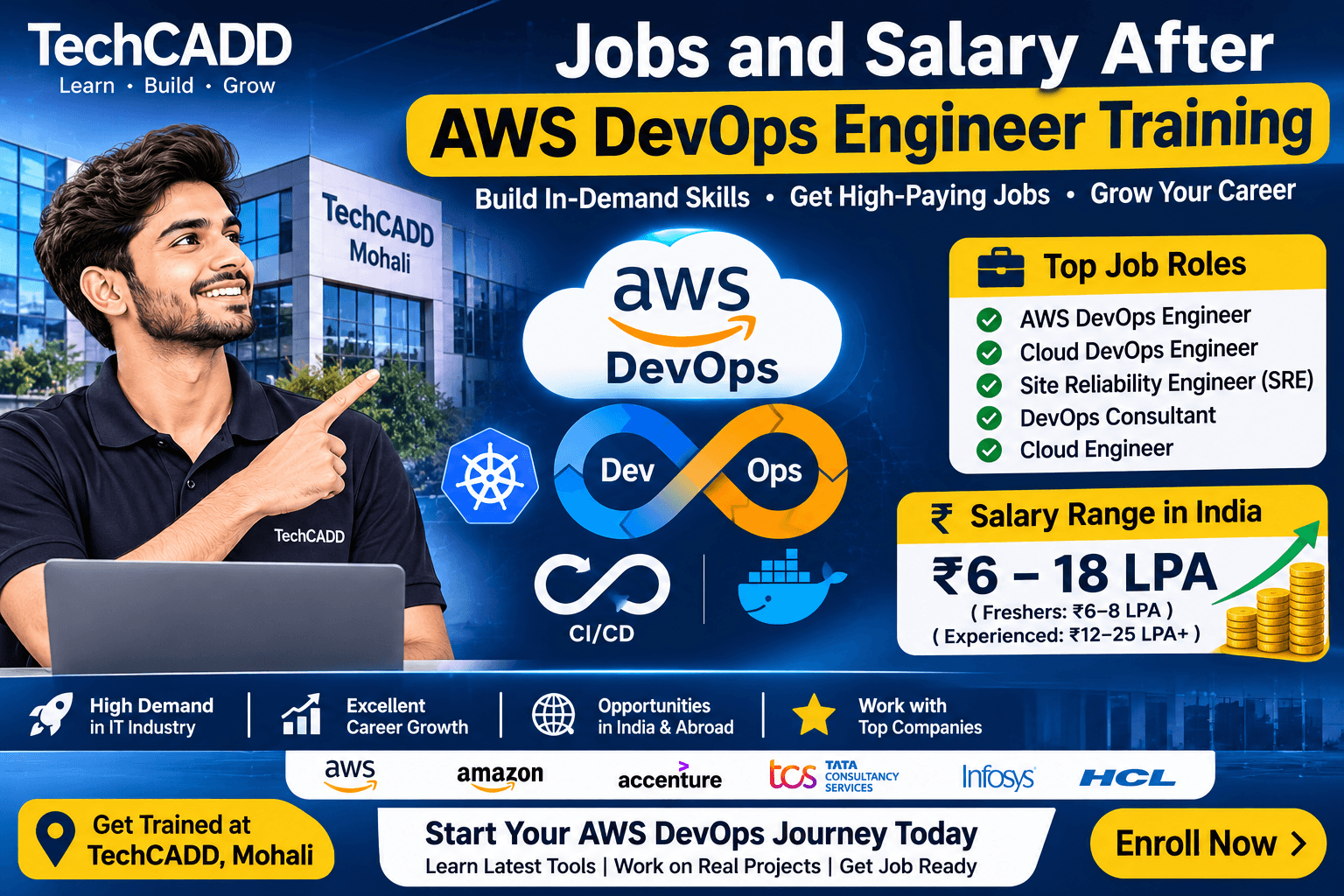
Introduction to AWS DevOps Engineering
Cloud computing has transformed how businesses develop, deploy and manage software applications. Organizations increasingly use cloud platforms to improve application availability, automate infrastructure management and deliver software more efficiently. Amazon Web Services (AWS) is one of the widely used cloud platforms supporting these requirements.
AWS DevOps engineering combines cloud computing, software development practices and automation. It focuses on improving the software delivery lifecycle through tools and processes for continuous integration, continuous delivery, infrastructure management, monitoring and deployment.
Completing AWS DevOps Engineer training can help learners develop practical knowledge of cloud infrastructure and automation. This guide explores the job roles, salary factors, essential skills and career opportunities available after learning AWS DevOps.
What Does an AWS DevOps Engineer Do?
An AWS DevOps Engineer helps development and operations teams build, deploy and maintain applications on AWS infrastructure. The role involves automating repetitive tasks, managing cloud resources and supporting reliable software delivery.
Typical responsibilities may include:
Managing cloud infrastructure and AWS resources.
Creating and maintaining CI/CD pipelines.
Automating application deployment processes.
Working with containerization and orchestration tools.
Monitoring application performance and infrastructure health.
Managing access permissions and cloud security configurations.
Troubleshooting deployment and infrastructure issues.
Collaborating with developers, testers and operations teams.
Jobs After AWS DevOps Engineer Training
After developing AWS and DevOps skills, learners can explore several entry-level and advanced career paths. The specific role depends on technical knowledge, practical experience, project exposure and employer requirements.
1. AWS Cloud Support Associate
An AWS Cloud Support Associate helps monitor and troubleshoot cloud environments. The role may involve assisting with infrastructure issues, investigating service interruptions and supporting customers or internal teams.
Skills that can be useful:
Understanding of AWS cloud services.
Basic networking and Linux knowledge.
Knowledge of EC2, S3 and IAM.
Cloud troubleshooting fundamentals.
Monitoring and documentation skills.
2. Junior DevOps Engineer
A Junior DevOps Engineer supports software development and deployment activities. Professionals in this role may help maintain repositories, configure automation workflows and troubleshoot application delivery pipelines.
Important skills include:
Git and GitHub version control.
Jenkins or GitHub Actions fundamentals.
Linux commands and shell scripting.
AWS infrastructure basics.
Understanding of CI/CD processes.
3. AWS Cloud Engineer
An AWS Cloud Engineer works with cloud infrastructure and services to support business applications. Responsibilities can include provisioning resources, configuring networks, managing storage and maintaining cloud environments.
Useful technical knowledge includes:
Amazon EC2 and S3.
Virtual Private Cloud (VPC).
Identity and Access Management (IAM).
CloudWatch monitoring.
Cloud networking and security fundamentals.
4. CI/CD Engineer
A CI/CD Engineer helps automate application building, testing and deployment. The role focuses on reducing manual processes and creating repeatable software delivery workflows.
Relevant skills include:
Jenkins and GitHub Actions.
Build and deployment automation.
Git branching and merging.
Automated testing concepts.
AWS deployment services.
5. Site Reliability Engineer (SRE)
Site Reliability Engineers focus on the reliability, availability and performance of applications and systems. This role generally requires a stronger understanding of infrastructure, automation, monitoring and production operations.
Important skills may include:
Linux system administration.
Cloud infrastructure management.
Monitoring and alerting.
Automation and scripting.
Incident response and troubleshooting.
6. Cloud Automation Engineer
A Cloud Automation Engineer works on automating cloud infrastructure provisioning and operational processes. Infrastructure as Code tools help teams create consistent and repeatable environments.
Useful skills include:
Terraform fundamentals.
AWS CloudFormation.
Python or shell scripting.
Configuration management.
Cloud resource automation.
AWS DevOps Engineer Salary in India
Salary after AWS DevOps Engineer training depends on several factors, including experience, practical knowledge, technical specialization, location, employer and project responsibilities. Completing a course does not automatically qualify someone for a particular salary or job title.
The following figures are broad illustrative annual salary ranges for career planning, not guaranteed offers or verified current market averages:
Experience Level
Illustrative Annual Salary Range
Entry-level / Fresher
₹2.5 lakh – ₹5 lakh
1–3 Years
₹4 lakh – ₹8 lakh
3–5 Years
₹7 lakh – ₹14 lakh
5–8 Years
₹12 lakh – ₹22 lakh
8+ Years
₹18 lakh – ₹30 lakh or more
Actual compensation can fall below or above these illustrative ranges. Senior positions involving architecture, large-scale infrastructure, security and production reliability may have different compensation structures.
Factors That Influence AWS DevOps Engineer Salary
1. Practical Experience
Employers often value candidates who have worked on real-world deployment workflows, cloud infrastructure and troubleshooting tasks. Practical experience can make a difference when applying for technical roles.
2. AWS Service Knowledge
Understanding services such as EC2, S3, IAM, VPC, CloudWatch, Lambda and CloudFormation can help professionals work with different cloud infrastructure requirements.
3. Automation Skills
Knowledge of Python, Bash, Terraform and CI/CD tools can help automate repetitive tasks and improve deployment workflows.
4. Industry and Company
Salary packages vary across startups, IT service companies, product organizations, consulting firms and multinational companies. Responsibilities and technical requirements also differ.
5. Certifications and Projects
Relevant AWS certifications can help demonstrate knowledge of cloud technologies. Practical projects and the ability to explain technical decisions are also valuable during recruitment.
AWS DevOps Engineer Training Syllabus
A structured AWS DevOps training programme should combine cloud fundamentals with automation, deployment and practical project work.
Module 1: Introduction to Cloud Computing
Cloud computing concepts and service models.
Introduction to AWS and its global infrastructure.
Regions and availability zones.
Cloud deployment models.
Basic networking concepts.
Module 2: AWS Core Services
Amazon EC2 and instance management.
Amazon S3 storage services.
IAM users, roles and permissions.
VPC and cloud networking.
Elastic Load Balancing.
Auto Scaling fundamentals.
Amazon RDS basics.
Module 3: Linux and Scripting
Linux operating system fundamentals.
Common Linux commands.
File and permission management.
Shell scripting basics.
Python scripting fundamentals.
System troubleshooting.
Module 4: Git and GitHub
Version control concepts.
Git installation and configuration.
Repository management.
Branching and merging.
Pull requests and code reviews.
Collaborative development workflows.
Module 5: CI/CD Pipeline Automation
Continuous Integration and Continuous Delivery concepts.
Jenkins installation and configuration.
Creating Jenkins pipelines.
GitHub Actions workflows.
Automated build and testing processes.
Deployment automation.
Module 6: Containers and Orchestration
Introduction to Docker.
Creating and managing Docker images.
Container networking and storage basics.
Amazon Elastic Container Registry (ECR).
Amazon Elastic Container Service (ECS).
Introduction to Kubernetes and Amazon EKS.
Module 7: Infrastructure as Code
Infrastructure as Code concepts.
Terraform fundamentals.
AWS CloudFormation basics.
Automated infrastructure provisioning.
Managing configuration and environments.
Module 8: Monitoring, Security and Deployment
Amazon CloudWatch monitoring.
Logging and alerting fundamentals.
AWS IAM security practices.
Secrets and environment configuration.
Application deployment strategies.
Backup and recovery concepts.
Cloud troubleshooting.
Practical AWS DevOps Projects for Your Portfolio
Projects help learners demonstrate how they apply DevOps concepts to application and infrastructure requirements. Some suitable projects include:
1. Automated Application Deployment
Build a CI/CD pipeline that retrieves source code from GitHub, executes build steps and deploys an application to an AWS environment.
2. Static Website Hosting on AWS
Create a static website deployment workflow using Amazon S3 and related AWS services. Practise updating the website through an automated process.
3. Docker Application Deployment
Containerize a sample application and explore how container images can be stored and deployed using AWS container services.
4. Infrastructure Provisioning with Terraform
Use Terraform to define and provision selected AWS resources. Learn how Infrastructure as Code improves consistency and repeatability.
5. Monitoring and Alerting Setup
Configure CloudWatch metrics, logs and alerts to understand application and infrastructure monitoring.
How to Start a Career After AWS DevOps Training
Building a career in AWS DevOps requires more than learning tool names. A structured preparation process can help you develop the skills employers expect.
Learn cloud fundamentals: Understand cloud computing, networking, Linux and AWS core services.
Practise Git and GitHub: Learn how to manage code changes and collaborate through repositories.
Build CI/CD pipelines: Practise automated builds, testing and deployments.
Explore containers: Learn Docker and understand container orchestration basics.
Study Infrastructure as Code: Practise Terraform or CloudFormation.
Create practical projects: Document your work and maintain a GitHub portfolio.
Prepare for interviews: Revise AWS concepts, Linux commands, networking and troubleshooting scenarios.
Apply for suitable roles: Start with internships, cloud support or junior DevOps opportunities where your skills match the requirements.
Certifications That Can Support Your AWS DevOps Career
Certifications can provide structured learning goals and demonstrate familiarity with cloud technologies. Some AWS certification paths to explore include:
AWS Certified Cloud Practitioner.
AWS Certified Solutions Architect - Associate.
AWS Certified Developer - Associate.
AWS Certified SysOps Administrator - Associate.
AWS Certified DevOps Engineer - Professional.
Choose a certification according to your experience and career goals. The professional-level DevOps certification is generally more suitable for candidates with substantial hands-on AWS and DevOps experience. Check AWS's official certification website for current exam details and prerequisites.
Why Consider AWS DevOps Training in Mohali?
Mohali and the surrounding Chandigarh region provide opportunities for students and working professionals to explore IT training and technical skill development. A structured AWS DevOps programme can help learners understand cloud services and practise automation workflows.
Before enrolling in an institute, evaluate these factors:
Coverage of AWS core services and DevOps fundamentals.
Hands-on access to cloud labs or suitable practice environments.
Training in Git, Jenkins, Docker and CI/CD pipelines.
Practical Infrastructure as Code exercises.
Trainer experience and doubt-clearing support.
Portfolio development and project guidance.
Transparent information about fees, duration and placement assistance.
Compare the course curriculum with your career goals and confirm which practical projects and learning resources are included.
Common Mistakes to Avoid When Learning AWS DevOps
Learning tools without understanding the underlying concepts.
Ignoring Linux and networking fundamentals.
Memorizing commands without practising them.
Skipping security and access-management concepts.
Building projects without documenting the workflow.
Assuming that completing one course guarantees a job.
Ignoring troubleshooting and monitoring skills.
Frequently Asked Questions (FAQs)
1. What jobs can I get after AWS DevOps Engineer training?
Depending on your skills and experience, you can explore roles such as Junior DevOps Engineer, AWS Cloud Engineer, Cloud Support Associate, CI/CD Engineer and Cloud Automation Engineer.
2. What is the salary of an AWS DevOps Engineer in India?
Salary varies by experience, location, company and technical expertise. Entry-level and experienced professionals can receive significantly different packages. Use current job listings and employer salary information when evaluating compensation.
3. Is AWS DevOps suitable for beginners?
Yes. Beginners can start with cloud computing fundamentals, Linux, networking and programming basics before progressing to AWS services and DevOps automation tools.
4. Which tools should I learn for AWS DevOps?
Important tools and technologies include Git, GitHub, Jenkins, GitHub Actions, Docker, Terraform, Linux, Python and AWS services such as EC2, S3, IAM and CloudWatch.
5. Are AWS certifications necessary for DevOps jobs?
Certifications are not mandatory for every role. They can demonstrate structured knowledge, but practical skills, projects and problem-solving ability are also important.
6. How long does it take to learn AWS DevOps?
The duration depends on your existing technical knowledge, course structure and practice time. Learners with programming and Linux experience may progress differently from complete beginners.
7. Can I get an AWS DevOps job as a fresher?
Freshers can explore internships, junior roles and cloud support opportunities. Building practical projects and understanding core cloud concepts can strengthen an entry-level application.
Conclusion
AWS DevOps offers a range of learning and career opportunities for people interested in cloud computing, software delivery and automation. By understanding AWS services, Linux, Git, CI/CD pipelines, containers, Infrastructure as Code and monitoring, learners can build a strong technical foundation.
If you are planning to pursue AWS DevOps Engineer training, focus on practical exercises, real-world projects and consistent skill development. Research the available job roles, understand employer expectations and build a portfolio that demonstrates your capabilities.
With the right combination of technical knowledge, hands-on experience and interview preparation, you can work towards opportunities in cloud engineering and DevOps.
Want this mapped to your own background and goals?
Talk to a counsellorMore on the blog
How to Prepare a Project Report & Viva for 6 Months College Industrial Training
Learn how to prepare a professional project report and confidently face your viva after six months of college industrial training. Explore report structure, documentation tips, project presentation, common viva questions and preparation strategies.
Top 9 High-Paying Tech & Engineering Courses for 6 Months Internship in 2026
Explore 9 high-paying technology and engineering courses for a six-month internship in 2026. Compare essential skills, tools, practical projects and career opportunities to choose the right training path.

Comments
No comments yet — yours would be the first.