


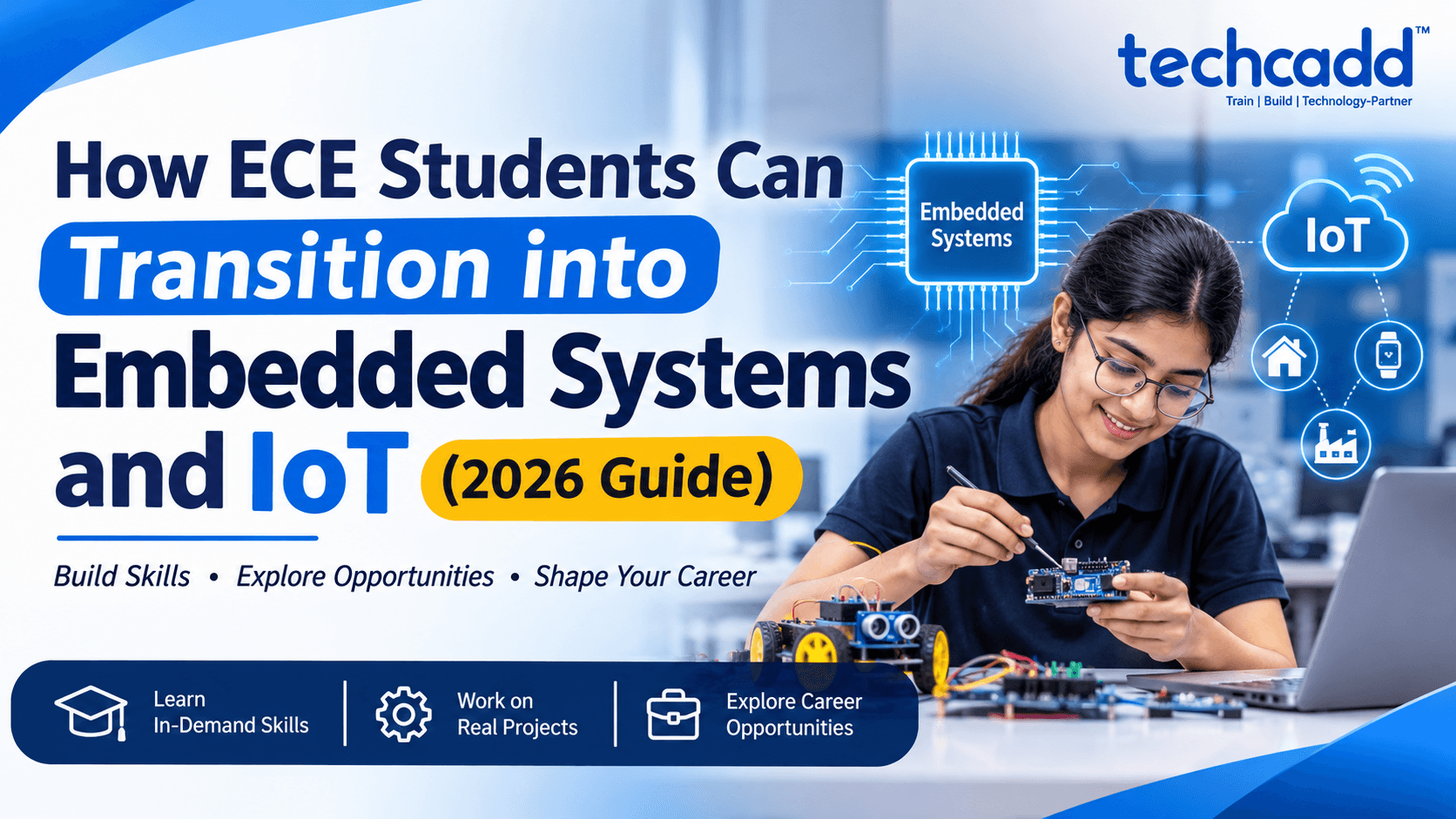
Electronics and Communication Engineering (ECE) graduates hold a rare advantage in the modern tech industry: you already understand circuit theory, digital electronics, signals, and microprocessors. Yet many ECE students feel pressured to abandon their core domain for generic IT support roles simply because university labs stop at basic 8051 kits.
In 2026, smart manufacturing, electric vehicles (EVs), medical devices, home automation, and industrial robotics are booming across India. Understanding how ECE students can transition into embedded systems and IoT allows you to combine your core hardware knowledge with modern firmware programming to land high-paying, future-proof engineering careers. At techcadd in Mohali, we bridge this exact gap through real hardware-kit labs and live industrial IoT projects.
Why Embedded Systems & IoT is the Best Core Career for ECE Graduates
Unlike pure software fields crowded with applicants from every background, embedded systems and Internet of Things (IoT) roles specifically value engineers who can read schematics, debug hardware protocols, and write memory-efficient firmware:
Strong Core Domain Alignment: Your academic background in analog/digital circuits, microcontrollers, and communication protocols directly applies on the job.
Exploding Industry Demand: Automotive electronics, smart energy meters, wearable health tech, and Industry 4.0 factories across Mohali, Chandigarh, Bengaluru, and Pune are actively hiring embedded firmware and IoT developers.
High Career Longevity: Hardware-integrated software is difficult to automate away, giving skilled embedded engineers strong long-term job security and salary growth.
Step-by-Step Roadmap: How ECE Students Can Transition into Embedded Systems and IoT
Follow this structured, practical roadmap to move from classroom theory to industry-ready firmware and IoT development:
Step 1: Master Embedded C and Low-Level Programming
Embedded systems run close to the hardware with strict memory and timing limits. Move beyond basic textbook C and master:
Pointers, Structures & Bitwise Operations: Manipulating hardware registers directly using bitmasks and volatile variables.
Memory Management: Understanding stack, heap, static memory allocation, and memory-mapped I/O.
Python for Automation & Edge Scripting: Using Python for serial testing, Raspberry Pi edge computing, and data logging.
Step 2: Transition from Basic Kits to Industry Microcontrollers
Recruiters look for hands-on experience with 32-bit architectures rather than outdated 8-bit boards:
ARM Cortex-M (STM32): Learn GPIO configuration, timers, interrupts, ADC/DAC, and DMA on industry-standard STM32 boards.
ESP32 & Raspberry Pi: Master Wi-Fi/Bluetooth-enabled microcontrollers (ESP32) and Linux-based Single Board Computers (Raspberry Pi) for connected IoT edge devices.
Step 3: Learn Essential Hardware Communication Protocols
Every embedded device talks to sensors, displays, and other chips using standardized protocols. Practice implementing and debugging:
Board-Level Protocols: UART, SPI, and I2C (using logic analyzers or oscilloscopes to inspect waveforms).
Industrial & Automotive Protocols: CAN bus, RS-485, and Modbus—crucial for EVs and industrial automation roles.
Step 4: Understand Real-Time Operating Systems (RTOS) & Embedded Linux
Complex IoT products handle multiple tasks simultaneously without missing deadlines:
FreeRTOS: Learn task scheduling, semaphores, mutexes, message queues, and interrupt service routines (ISRs).
Embedded Linux Basics: Understand bootloaders, cross-compilation, device drivers, and Linux shell scripting.
Step 5: Connect Hardware to IoT Cloud Platforms & Edge AI
An embedded device becomes an IoT solution when it securely communicates with the cloud:
IoT Messaging Protocols: MQTT, HTTP/REST APIs, CoAP, and WebSockets.
Cloud Integration & Dashboards: Stream live sensor telemetry to AWS IoT Core, Azure IoT, or Node-RED/Grafana dashboards with TLS encryption.
TinyML / Edge AI: Run lightweight machine learning models directly on microcontrollers for predictive maintenance or anomaly detection.
Must-Build Portfolio Projects for ECE Resumes
Replace generic academic projects with practical, end-to-end prototypes that demonstrate both hardware interfacing and cloud connectivity:
Smart Industrial Predictive Maintenance Node: An STM32/ESP32 system reading vibration and temperature sensors over I2C/SPI, running FreeRTOS tasks, and publishing alerts via MQTT to a live cloud dashboard.
EV Battery Management System (BMS) Monitor: A CAN-bus-enabled prototype tracking cell voltage, current, and thermal thresholds with real-time fault logging.
Smart Energy & Home Automation Gateway: A secure Wi-Fi/BLE controller with mobile app telemetry and automated power scheduling.
Top Job Roles After Transitioning into Embedded & IoT
Once you build hands-on competence, you can apply for specialized roles such as:
Embedded Firmware Engineer
IoT Solutions Developer
Hardware Design & Validation Engineer
Embedded Linux / RTOS Developer
Automotive Electronics Engineer
Launch Your Embedded Systems & IoT Career at techcadd in Mohali
Knowing how ECE students can transition into embedded systems and IoT becomes effortless when you practice on real development boards under industry mentors. At techcadd in Mohali, our 6-month Embedded Systems and IoT industrial training program gives ECE students hands-on lab access to STM32, ESP32, Raspberry Pi, FreeRTOS, and cloud IoT platforms—backed by live capstone projects and 100% placement assistance.
Visit techcadd in Mohali today or book a free career counseling session and hardware lab demo to turn your ECE degree into a high-growth core engineering career!
Want this mapped to your own background and goals?
Talk to a counsellorMore on the blog
How to Prepare a Project Report & Viva for 6 Months College Industrial Training
Learn how to prepare a professional project report and confidently face your viva after six months of college industrial training. Explore report structure, documentation tips, project presentation, common viva questions and preparation strategies.
Top 9 High-Paying Tech & Engineering Courses for 6 Months Internship in 2026
Explore 9 high-paying technology and engineering courses for a six-month internship in 2026. Compare essential skills, tools, practical projects and career opportunities to choose the right training path.

Comments
No comments yet — yours would be the first.