


Quick answer: Google Cloud Platform (GCP) training teaches you how to build, deploy and manage applications on Google Cloud. Beginners start with cloud basics, the Cloud Console, IAM, Compute Engine, Cloud Storage and VPC networking, then move to Cloud Run, GKE and BigQuery. With hands-on labs and small projects, most beginners in Mohali can become job-ready for entry-level cloud roles and prepare for the Cloud Digital Leader or Associate Cloud Engineer certification in a few months.
Table of contents
What Is Google Cloud Platform Training?
Google Cloud Platform is Google's suite of cloud services for computing, storage, networking, databases, data analytics and AI. GCP training is a structured way to learn these services through concepts, guided labs and real projects, so you understand not only what each service does but also when and how to use it in a real application.
A good beginner programme focuses on the fundamentals first, including projects, billing, regions and zones, and identity, before moving into deployment, containers and data services.
Who Should Learn GCP?
Students and freshers (B.Tech, BCA, MCA, diploma) who want a cloud skill on their resume.
Developers who want to deploy web apps and APIs on serverless platforms such as Cloud Run.
System and network administrators moving from on-premise servers to cloud infrastructure.
Data and analytics learners interested in BigQuery and Google's data tools.
You do not need prior cloud experience. Basic computer skills, some familiarity with Linux commands and a willingness to practise are enough to start.
Core GCP Services You Will Learn
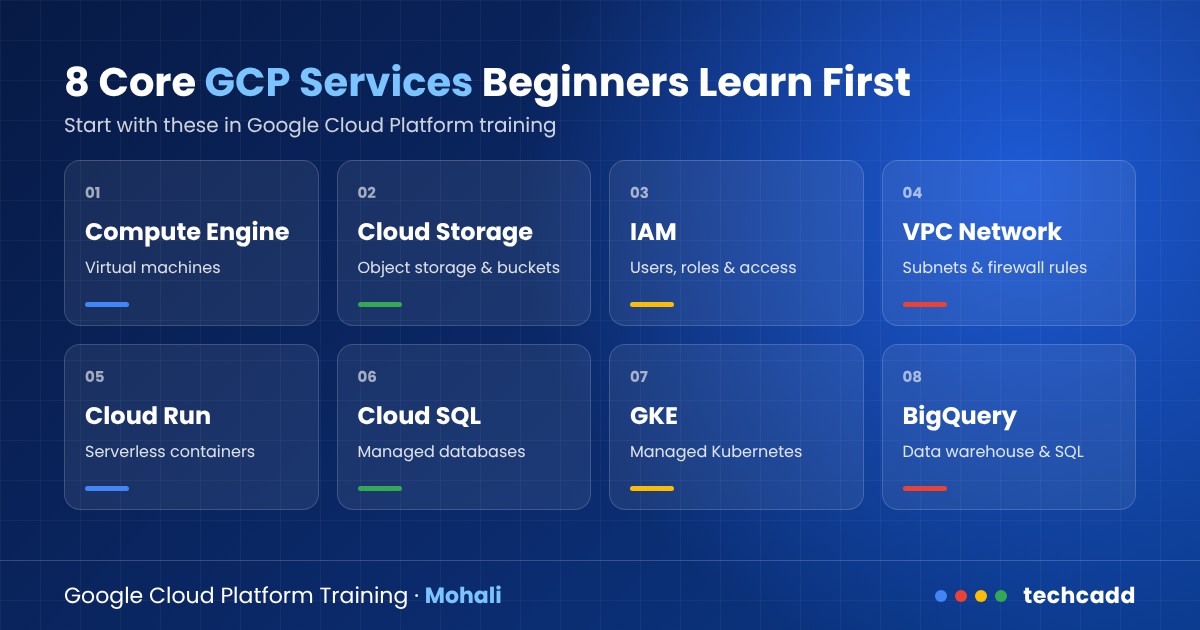
Compute Engine: create and manage virtual machines, machine types, disks and snapshots.
Cloud Storage: store files in buckets, set storage classes and manage access.
IAM: control who can do what with users, groups, service accounts and roles.
VPC networking: subnets, firewall rules, routes and load balancing.
Cloud Run: run containerised apps without managing servers.
Cloud SQL: managed MySQL and PostgreSQL databases.
Google Kubernetes Engine (GKE): deploy and scale containers with managed Kubernetes.
BigQuery: analyse large datasets with standard SQL.
Alongside these services you will also use the Cloud Console, Cloud Shell and the gcloud command-line tool, which are the everyday tools of a cloud engineer.
Six-Week Learning Plan
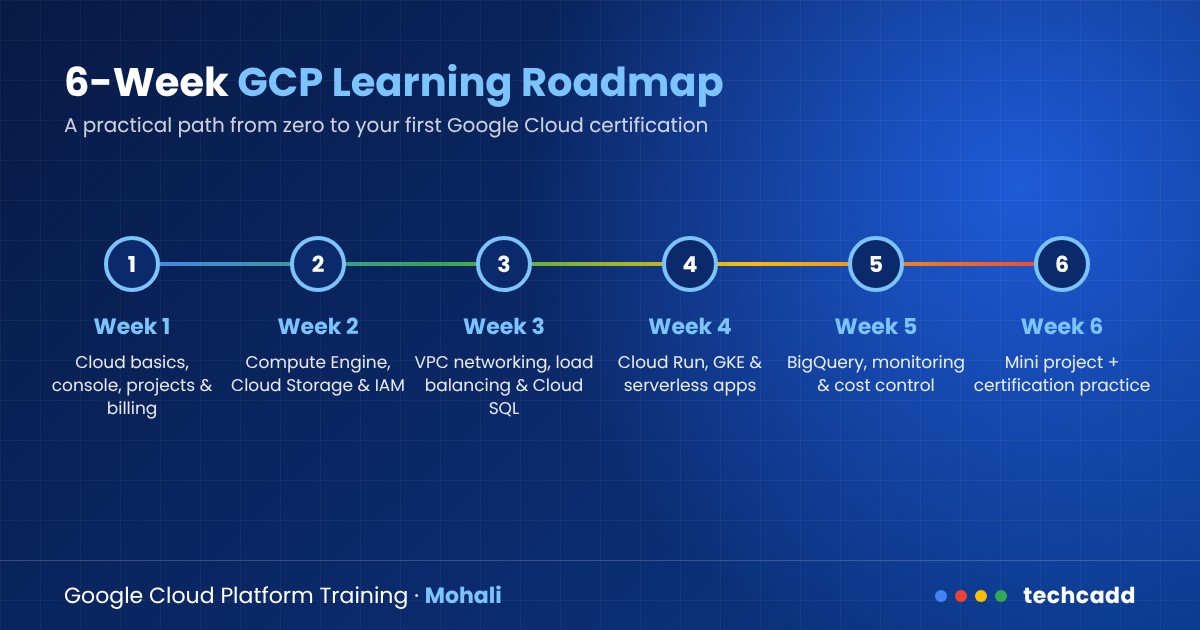
Week 1: Cloud concepts, GCP global infrastructure, projects, billing and the Cloud Console.
Week 2: Compute Engine, Cloud Storage and IAM with hands-on labs.
Week 3: VPC networking, firewall rules, load balancing and Cloud SQL.
Week 4: Containers with Cloud Run and an introduction to GKE.
Week 5: BigQuery basics, Cloud Monitoring, logging and cost control.
Week 6: A mini project, revision and certification practice tests.
A simple capstone project, such as deploying a web app on Cloud Run with a Cloud SQL database and files stored in Cloud Storage, ties all of these skills together and gives you something concrete to show in interviews.
Beginner Tips for Learning GCP
Use the Google Cloud free trial and Free Tier carefully, and set budget alerts from day one.
Practise every concept in the Console first, then repeat it with gcloud commands in Cloud Shell.
Delete resources you no longer need so you do not run up unexpected charges.
Learn IAM and networking well, because most real-world issues trace back to permissions or network rules.
Document your projects on GitHub with screenshots and architecture diagrams.
Certifications and Career Paths
Beginners usually start with Cloud Digital Leader, a foundational certification that covers cloud concepts and Google Cloud products. Hands-on learners can then target Associate Cloud Engineer, which validates deploying applications, monitoring operations and managing enterprise solutions on GCP. Later, you can move to professional certifications such as Professional Cloud Architect or Professional Cloud DevOps Engineer.
Entry-level roles include cloud support associate, junior cloud engineer, cloud operations engineer and DevOps trainee. Read more in our guide to GCP certification and career opportunities in Mohali.
Frequently Asked Questions
Is Google Cloud Platform good for beginners?
Yes. GCP has a clean console, strong documentation and a free trial, which makes it a practical first cloud platform for students and freshers.
Do I need coding to learn GCP?
Not to start. Core services can be learned through the Console. Basic Linux commands and some scripting will help as you move to automation, containers and DevOps.
How long does GCP training take?
Fundamentals can be covered in about six weeks with regular practice. Becoming confident for Associate Cloud Engineer level work usually takes two to three months of hands-on study.
Which GCP certification should I take first?
Cloud Digital Leader is a good first step for non-technical or new learners. If you are comfortable with hands-on labs, you can go directly to Associate Cloud Engineer. Always check Google Cloud's official exam guides for the latest details.
Google Cloud Platform Training and Internships in Mohali
If you want to learn Google Cloud Platform with hands-on practice, techcadd Mohali offers classroom training, project work and industrial training options for students, graduates and working professionals:
GCP Fundamentals course in Mohali – syllabus, tools and projects
6-week industrial training in Mohali – for B.Tech, BCA, MCA and diploma students
6-month industrial training in Mohali – project-based training with a live project
Internship programme in Mohali – eligibility and how to apply
Explore Google Cloud Platform Training at techcadd Mohali
View the GCP Fundamentals course syllabus or enquire about admissions at techcadd, Mohali. Our counsellors can help you choose between a short-term course, 6-week industrial training and 6-month industrial training based on your background.
Related Articles
Want this mapped to your own background and goals?
Talk to a counsellorMore on the blog
AI/ML Computer Vision: Skills You Will Learn and Career Roadmap for 2026
Explore the essential AI and machine learning computer vision skills for 2026. Learn Python, OpenCV, deep learning, object detection, image segmentation, practical projects, and a step-by-step career roadmap to become a computer vision engineer.
Why techcadd Mohali? Discover What Defines Us
Why techcadd Mohali? Harrachneet Kaur Sandhu explores the values and practical learning approach that define techcadd. Discover how students and professionals can build skills, explore emerging technologies and prepare for evolving industry expectations through continuous learning and growth daily.

Comments
No comments yet — yours would be the first.