


Introduction: Start Your Data Science Journey in 2026
Data is an important resource for businesses across industries. Organisations use data to understand customers, improve operations, identify trends and make informed decisions. This growing reliance on data has increased interest in skills such as Python programming, statistics, data analytics and machine learning.
If you are planning to enter this field, a structured learning roadmap can help you understand what to study and how to practise. A six-month industrial training programme can provide a guided pathway from programming fundamentals to data analysis, machine learning and portfolio development.
This guide explains what learners can aim to cover during six months of Data Science training in 2026, including key tools, practical exercises, projects and career preparation. TechCadd Mohali is one training option learners can explore while comparing course syllabuses, practical facilities and instructor support.
What Is Data Science?
Data Science combines programming, mathematics, statistics and domain knowledge to extract useful insights from structured and unstructured data. It involves collecting, cleaning, analysing and interpreting information, and sometimes building predictive models using machine learning.
Common areas within Data Science include:
Data collection: Gathering information from databases, files, APIs and other sources.
Data cleaning: Handling missing values, duplicates and inconsistent records.
Exploratory data analysis: Identifying patterns, relationships and trends.
Data visualisation: Communicating findings through charts, graphs and dashboards.
Machine learning: Building models that learn patterns from data.
Business interpretation: Translating analytical results into useful recommendations.
Why Follow a Six-Month Data Science Roadmap?
Data Science covers several connected subjects. Learning everything without a plan can become confusing, especially for beginners. A six-month roadmap divides the learning process into manageable stages.
Build programming and analytical foundations before studying advanced models.
Practise with tools commonly used in data analysis workflows.
Work with datasets instead of relying only on theoretical explanations.
Develop projects that demonstrate practical problem-solving skills.
Prepare a portfolio and identify areas for further learning.
The six-month structure is a suggested learning plan, not a guarantee of mastery or employment. Your progress will depend on your starting knowledge, practice time and project experience.
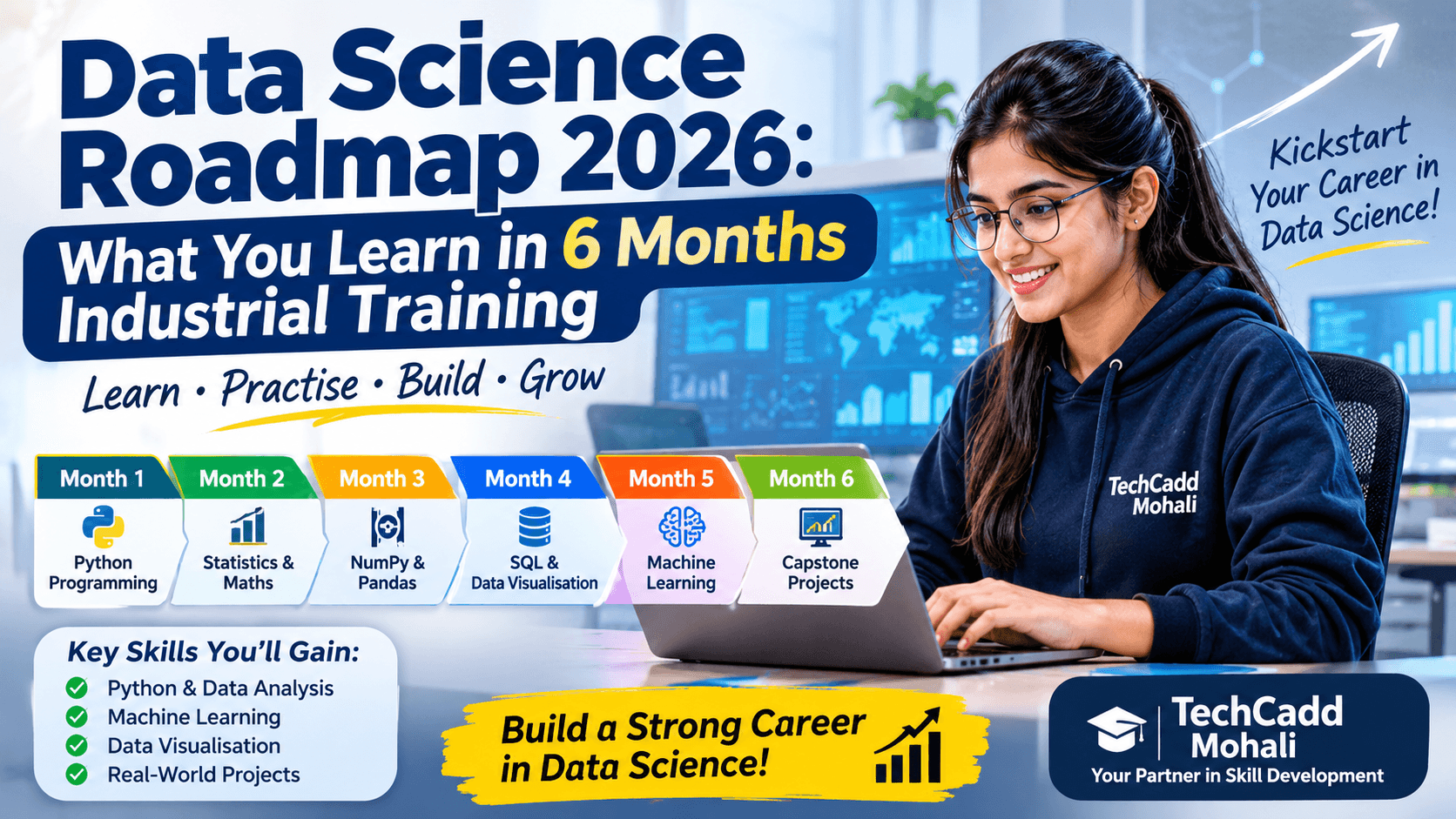
Six-Month Data Science Industrial Training Roadmap for 2026
Month 1: Python Programming Fundamentals
Python is widely used in Data Science because it has a readable syntax and a large ecosystem of libraries. The first month should focus on developing programming confidence.
Topics to learn:
Python syntax, variables and data types
Operators, conditional statements and loops
Lists, tuples, dictionaries and sets
Functions and modules
File handling and exception handling
Introduction to Jupyter Notebook and development environments
Practice activity: Create small Python programs to calculate expenses, process student records and summarise information from CSV files.
Learning outcome: Understand how to write, test and organise basic Python programs.
Month 2: Statistics, Mathematics and Data Analysis
Data Science requires the ability to understand what data represents. The second month introduces the statistical concepts used to analyse datasets and interpret results.
Topics to learn:
Mean, median and mode
Range, variance and standard deviation
Probability fundamentals
Distributions and sampling concepts
Correlation and basic statistical relationships
Introduction to hypothesis testing
Data types and descriptive analysis
Practice activity: Analyse a sample sales or student-performance dataset and calculate summary statistics.
Learning outcome: Develop a foundation for interpreting data and understanding analytical results.
Month 3: NumPy, Pandas and Data Cleaning
Once Python and statistics fundamentals are in place, learners can move to libraries designed for working with data. NumPy supports numerical computing, while Pandas provides tools for manipulating tabular datasets.
Topics to learn:
NumPy arrays and array operations
Pandas Series and DataFrames
Importing CSV and Excel files
Filtering, sorting and grouping data
Handling missing and duplicate values
Data transformation and merging datasets
Basic exploratory data analysis
Practice activity: Clean a customer or retail dataset, handle missing information and generate summary reports.
Learning outcome: Become comfortable preparing real-world datasets for analysis.
Month 4: SQL, Data Visualisation and Reporting
Data professionals often work with information stored in relational databases. Visualisation is equally important because analytical findings need to be communicated clearly.
Topics to learn:
SQL SELECT, WHERE, ORDER BY and GROUP BY
Joins, aggregate functions and subqueries
Database tables and relationships
Matplotlib and Seaborn fundamentals
Bar charts, line charts, histograms and scatter plots
Data storytelling and visual interpretation
Introduction to dashboard concepts and reporting tools
Practice activity: Query a sample database and build visual reports that explain sales trends, customer segments or business performance.
Learning outcome: Retrieve information using SQL and present insights through appropriate visualisations.
Month 5: Machine Learning Fundamentals
Machine learning allows computers to identify patterns in data and make predictions or classifications. Learners should first understand the purpose and limitations of different model types.
Topics to learn:
Introduction to machine learning and its applications
Supervised and unsupervised learning
Regression and classification
Linear regression and logistic regression
Decision trees and random forests
Clustering fundamentals, including K-means
Training and testing datasets
Model evaluation and overfitting
Introduction to Scikit-learn
Practice activity: Build a basic prediction model using a suitable public dataset. Compare model results using appropriate evaluation metrics.
Learning outcome: Understand a basic machine learning workflow, from preparing data to evaluating a model.
Month 6: Capstone Projects, Portfolio and Career Preparation
The final month should bring together the skills developed throughout the programme. Learners can complete an end-to-end project that demonstrates their ability to solve a defined data problem.
Topics and activities:
Selecting a suitable project problem
Collecting or selecting a relevant dataset
Cleaning and exploring data
Creating visualisations and interpreting findings
Building and evaluating a suitable machine learning model
Documenting the project and explaining decisions
Preparing a GitHub portfolio and project presentation
Resume preparation and technical interview practice
Learning outcome: Complete a portfolio-ready project and learn how to communicate the process, results and limitations.
Practical Data Science Projects to Build During Training
Projects help learners apply concepts to problems that resemble real analytical tasks. Some beginner-friendly project ideas include:
1. Student Performance Analysis
Analyse a student dataset to explore how attendance, study time and other available factors relate to academic performance. Use Pandas for cleaning and visualisation libraries to communicate findings.
2. Sales Data Analysis
Work with retail sales records to identify monthly trends, popular products and revenue patterns. Use SQL or Pandas to summarise the information and create charts for reporting.
3. Customer Segmentation
Explore customer characteristics and use a clustering method such as K-means to create groups based on selected features. Explain the assumptions and limitations of the analysis.
4. House Price Prediction
Use a suitable dataset to explore the relationship between property features and prices. Build a regression model and evaluate its performance on unseen data.
5. Exploratory Data Analysis Dashboard
Prepare a dataset, identify key trends and create a dashboard or visual report. Focus on clear labels, useful comparisons and meaningful conclusions.
Tools and Technologies You May Learn
Tool or TechnologyPurpose
PythonProgramming and data processing
Jupyter NotebookInteractive coding and analysis
NumPyNumerical computing
PandasData manipulation and cleaning
SQLDatabase querying
Matplotlib and SeabornData visualisation
Scikit-learnMachine learning workflows
Git and GitHubVersion control and project sharing
The exact tools covered can vary by training provider. Confirm the current syllabus before enrolling.
Why Consider TechCadd Mohali for Data Science Industrial Training?
Choosing a training institute is an important part of planning your learning journey. TechCadd Mohali is one option learners can explore when looking for Data Science and technical training in the Mohali region.
Structured Six-Month Learning Plan
A structured programme can help learners progress from Python basics to data analysis and machine learning. Ask whether the course follows a clear sequence and how much time is allocated to each subject.
Practical, Project-Based Learning
Data Science requires regular practice. Look for training that includes dataset exploration, coding exercises, guided assignments and end-to-end projects rather than focusing only on presentations.
Guidance from Trainers
Trainer support can help learners understand programming errors, statistical concepts and model evaluation. Before enrolling, ask about trainer experience and how doubts are addressed during and after sessions.
Portfolio Development
A portfolio can help demonstrate your practical skills to potential employers. Find out whether the training includes project documentation, GitHub guidance and opportunities to present your work.
Career Preparation
Interview practice, resume guidance and discussions about job requirements can help learners prepare for the recruitment process. Confirm which career-support services are actually included in the programme.
Career Opportunities After Data Science Training
After developing programming, analytics and project skills, learners may explore entry-level roles or related positions depending on their qualifications and experience.
Data Analyst: Collects, cleans and analyses data to support business decisions.
Junior Data Scientist: Supports data exploration, model development and analytical projects.
Business Intelligence Analyst: Creates reports and dashboards to communicate business performance.
Python Developer: Uses Python to build scripts, tools and data-related applications.
Machine Learning Associate: Assists with preparing datasets, testing models and evaluating results.
These roles have different requirements. A six-month course can provide a foundation, but employment may also require a relevant degree, strong problem-solving ability, additional experience and continued learning.
How to Make the Most of Your Six Months
Practise Python regularly instead of memorising syntax.
Work with different datasets to understand data quality issues.
Strengthen statistics and basic mathematics alongside coding.
Write SQL queries and explain what each query returns.
Build projects that answer clear questions.
Document your code and analytical decisions.
Use GitHub to organise and present selected projects.
Review model limitations and avoid making unsupported conclusions.
Frequently Asked Questions
1. Can I learn Data Science in six months?
Six months can provide a structured introduction to Python, statistics, data analysis, SQL, visualisation and machine learning fundamentals. Becoming job-ready may require additional practice and deeper study.
2. Is Python necessary for Data Science?
Python is one of the most widely used languages for Data Science. It supports data manipulation, visualisation, automation and machine learning through libraries such as Pandas, NumPy and Scikit-learn.
3. Do I need mathematics to study Data Science?
Basic mathematics and statistics are important. Learners should gradually become comfortable with averages, variation, probability, correlation and other concepts used in data analysis and machine learning.
4. What projects should beginners build?
Beginners can start with sales analysis, student performance analysis, customer segmentation, exploratory data analysis and simple prediction projects using public datasets.
5. Is industrial training useful for freshers?
Industrial training can provide structure, guided practice and project experience. Its value depends on the quality of instruction, practical work and the learner's effort.
6. What should I check before joining a Data Science course in Mohali?
Review the syllabus, trainer experience, practical lab access, project work, batch timings, course fees and career-support services. Ask for details about the six-month learning schedule.
Conclusion
A six-month Data Science roadmap can help beginners organise their learning and build a foundation in Python, statistics, data analysis, SQL, visualisation and machine learning. The most important part of the journey is consistent practice with real datasets and projects that demonstrate problem-solving ability.
If you are considering Data Science industrial training in Mohali, explore the programme offered by TechCadd Mohali alongside other available options. Compare the syllabus, practical sessions, project opportunities and trainer support before enrolling. With a clear learning plan and regular hands-on work, you can take meaningful steps towards a career in the data field in 2026 and beyond.
Want this mapped to your own background and goals?
Talk to a counsellorMore on the blog
How to Prepare a Project Report & Viva for 6 Months College Industrial Training
Learn how to prepare a professional project report and confidently face your viva after six months of college industrial training. Explore report structure, documentation tips, project presentation, common viva questions and preparation strategies.
Top 9 High-Paying Tech & Engineering Courses for 6 Months Internship in 2026
Explore 9 high-paying technology and engineering courses for a six-month internship in 2026. Compare essential skills, tools, practical projects and career opportunities to choose the right training path.

Comments
No comments yet — yours would be the first.