


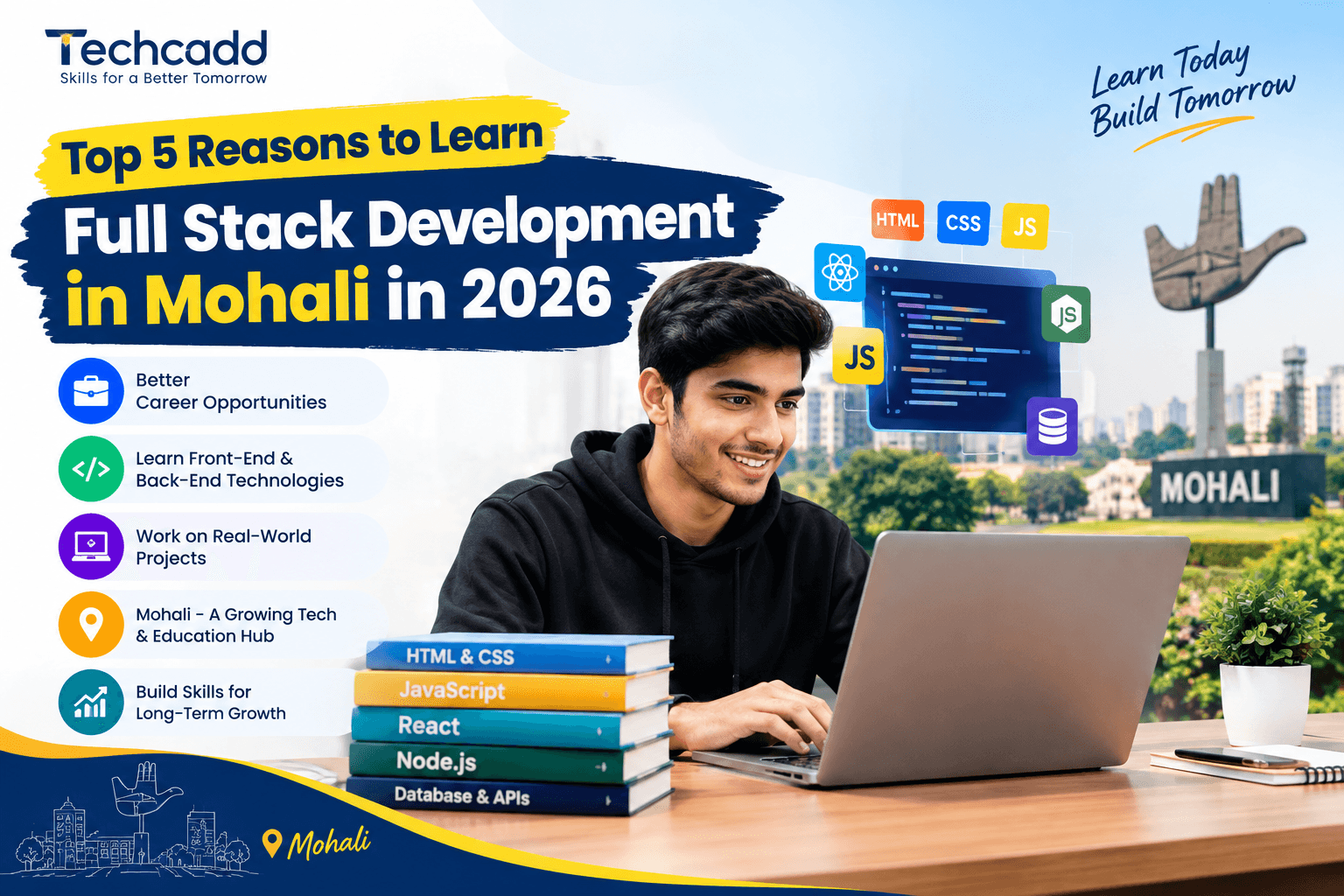
Complete Full Stack Developer Roadmap for 6 Months Industrial Training in Mohali
Web applications are an important part of modern businesses, from online shopping platforms and educational portals to banking systems and business management software. Behind these applications are developers who build the visual interfaces users interact with and the server-side systems that process information.
Full Stack Development combines both areas of web development. A Full Stack Developer works with frontend technologies, backend programming, databases, APIs and application deployment. For students who want to build a career in software development, six months of structured industrial training can provide a practical starting point.
If you are searching for a Full Stack Developer roadmap for six months of industrial training in Mohali, this guide explains the technologies to learn, monthly learning goals, project ideas and career preparation steps.
1. What Is Full Stack Development?
Full Stack Development is the process of building both the frontend and backend components of a web application.
The frontend is the part of a website or application that users see and interact with. It includes layouts, navigation, forms, buttons, menus and interactive elements.
The backend handles application logic, authentication, data processing, APIs and communication with databases. It works behind the scenes to make the application function correctly.
A Full Stack Developer understands how these components connect and how data moves between the browser, server and database.
Main Areas of Full Stack Development
Frontend Development: Creating responsive and interactive user interfaces.
Backend Development: Building server-side logic and application functionality.
Database Management: Storing, retrieving and managing application information.
API Integration: Connecting frontend applications with backend services.
Testing and Debugging: Identifying errors and checking application behaviour.
Deployment: Making applications available to users through hosting platforms.
2. Why Choose Full Stack Development for Industrial Training?
Industrial training gives students an opportunity to move beyond classroom concepts and practise technologies used in software projects. It can help learners understand development workflows, work with code repositories and build applications from the planning stage to deployment.
Some important benefits include:
Understanding how modern websites and applications are developed.
Practising frontend and backend technologies together.
Learning how databases and APIs work.
Building projects that demonstrate technical abilities.
Developing debugging and problem-solving skills.
Understanding teamwork, version control and development workflows.
3. Essential Technologies Every Full Stack Developer Should Learn
HTML5 – Building Webpage Structure
HTML stands for HyperText Markup Language. It provides the basic structure of a webpage. Developers use HTML elements to organise headings, paragraphs, images, links, forms, tables and other content.
Important topics include:
HTML document structure and semantic elements.
Headings, paragraphs, links and images.
Forms and input elements.
Tables and lists.
Accessibility fundamentals.
CSS3 – Designing Responsive Interfaces
CSS, or Cascading Style Sheets, controls the appearance and layout of webpages. It helps developers create attractive interfaces that adapt to different screen sizes.
Learn the following concepts:
Selectors, properties and the box model.
Colours, typography, borders and spacing.
Flexbox and CSS Grid.
Positioning and responsive design.
Media queries and transitions.
Reusable styling techniques.
JavaScript – Adding Interactivity
JavaScript is a programming language used to make websites interactive. It allows developers to validate forms, respond to user actions, update webpage content and communicate with backend services.
Important topics include:
Variables, data types and operators.
Conditional statements and loops.
Functions and scope.
Arrays and objects.
DOM manipulation and browser events.
Promises, async/await and API requests.
ES6+ features.
React.js – Developing Modern Frontend Applications
React is a JavaScript library used to build component-based user interfaces. It helps developers organise large interfaces into smaller, reusable components.
Focus on:
Components and JSX.
Props and state.
Event handling.
Conditional rendering and lists.
Hooks such as useState and useEffect.
React Router fundamentals.
API integration and form handling.
Node.js – Backend JavaScript Development
Node.js allows developers to run JavaScript outside the browser. It is commonly used to build backend services, APIs and server-side applications.
Learn:
Node.js fundamentals.
Modules and package management.
Working with files and environment variables.
Asynchronous programming.
HTTP server fundamentals.
Error handling and debugging.
Express.js – Building Backend APIs
Express.js is a web framework for Node.js. It simplifies the development of server-side applications and REST APIs.
Important concepts include:
Creating an Express server.
Routes and HTTP methods.
Middleware.
Request and response handling.
Input validation and error handling.
Authentication and authorisation basics.
MongoDB – Managing Application Data
MongoDB is a document-oriented NoSQL database. It stores information in flexible document structures and is frequently used in MERN Stack applications.
Learn how to:
Create databases and collections.
Insert, read, update and delete documents.
Filter and query records.
Understand document relationships.
Connect MongoDB with Node.js and Express.
Git and GitHub – Managing Source Code
Version control is an important part of software development. Git tracks changes in code, while GitHub provides a platform for hosting repositories and collaborating with other developers.
Practise:
Creating repositories.
Using git add, commit, push and pull.
Creating and switching branches.
Understanding merge conflicts.
Writing useful README files.
4. Complete Six-Month Full Stack Developer Roadmap
Month 1: HTML, CSS and Web Development Fundamentals
Start by understanding how websites are structured and styled. Learn HTML and CSS before moving towards JavaScript.
Topics to cover:
HTML5 elements and semantic structure.
CSS selectors and styling.
Flexbox and Grid layouts.
Responsive web design.
Basic website accessibility.
Practical projects:
Personal portfolio webpage.
Responsive business landing page.
Simple product or service website.
Monthly goal: Build responsive static webpages and understand how frontend layouts work.
Month 2: JavaScript and Frontend Programming
After learning webpage structure and styling, focus on JavaScript. This month should help you understand programming logic and how websites respond to user actions.
Topics to cover:
Variables, functions and data types.
Conditions, loops and arrays.
Objects and array methods.
DOM manipulation.
Events and form validation.
Fetch API and asynchronous JavaScript.
Practical projects:
To-do list application.
Interactive calculator.
Weather application using an API.
Monthly goal: Write basic JavaScript programs and create interactive webpages.
Month 3: React.js and Frontend Application Development
Learn how to build modern user interfaces using React. Focus on reusable components and managing application data.
Topics to cover:
React setup and project structure.
JSX and reusable components.
Props and state.
React Hooks.
React Router.
API integration.
Forms and basic frontend validation.
Practical projects:
Product listing interface.
Student dashboard.
Movie search application using an API.
Monthly goal: Develop a multi-page frontend application using React.
Month 4: Node.js, Express.js and Backend Development
Move towards server-side programming. Learn how a backend receives requests, processes information and sends responses to frontend applications.
Topics to cover:
Node.js fundamentals.
Express server setup.
REST API development.
HTTP methods and status codes.
Middleware and routing.
Input validation and error handling.
Authentication fundamentals.
Practical projects:
Simple notes API.
Task management backend.
User registration and login API.
Monthly goal: Build backend services and understand how APIs connect applications.
Month 5: MongoDB, Full Stack Integration and GitHub
Now combine the frontend and backend. Learn how application data is stored, retrieved and displayed to users.
Topics to cover:
MongoDB database and collection concepts.
CRUD operations.
Connecting MongoDB with Express.
Frontend-to-backend API integration.
Authentication and protected routes.
Git and GitHub workflows.
Environment variables and basic application security.
Practical projects:
Full Stack task manager.
Student management application.
Basic e-commerce application.
Monthly goal: Build an application in which React, Node.js, Express and MongoDB work together.
Month 6: Final Project, Testing and Deployment
The final month should focus on developing a complete project, testing important workflows and preparing a professional portfolio.
Topics to cover:
Application planning and folder organisation.
Frontend and backend integration.
Form validation and error handling.
Testing important application workflows.
Deployment fundamentals.
Environment configuration.
Project documentation and GitHub portfolio.
Final project ideas:
Online learning management system.
Job portal with user registration.
E-commerce platform with product and order management.
Appointment booking application.
Monthly goal: Complete and document at least one substantial Full Stack project that demonstrates your understanding of frontend, backend and database integration.
5. Best Full Stack Projects for Industrial Training
Projects help demonstrate how well you can apply the technologies covered during training. Instead of creating many incomplete applications, focus on a few projects with working features.
Project 1: Student Management System
Create an application that allows authorised users to add, update, view and delete student records. Include search, filtering and form validation.
Technologies: React, Node.js, Express and MongoDB.
Project 2: E-commerce Website
Build an online shopping application with product listings, product details, user accounts and a shopping cart. You can add order management as an advanced feature.
Technologies: React, Express, Node.js and MongoDB.
Project 3: Job Portal Application
Create a platform where candidates can view job listings and submit applications. Add a separate interface for recruiters to manage job postings.
Technologies: React, Node.js, Express, MongoDB and REST APIs.
Project 4: Online Learning Platform
Develop a platform where learners can browse courses, view lessons and track their learning progress. Include user authentication and course management.
Technologies: React, Node.js, Express and MongoDB.
6. How to Build a Strong Full Stack Developer Portfolio
A portfolio helps employers and interviewers understand what you can build. It should highlight practical work rather than simply list programming languages.
Personal portfolio website: Introduce yourself, your skills and your projects.
GitHub repositories: Upload clean, organised source code.
Project descriptions: Explain the problem, technologies and important features.
Live project links: Share deployed applications where possible.
README documentation: Explain installation, setup and usage.
Development improvements: Show how you debugged or improved an application.
7. Career Opportunities After Full Stack Development Training
After developing the required technical skills and practical experience, learners can explore several entry-level software development roles. Job titles and responsibilities differ between companies.
Frontend Developer: Builds user interfaces using HTML, CSS, JavaScript and frontend frameworks.
Backend Developer: Develops server-side logic, APIs and database interactions.
Full Stack Developer: Works across frontend and backend application components.
React Developer: Develops component-based interfaces using React.
Node.js Developer: Builds backend applications and services using Node.js.
Web Developer: Creates and maintains websites and web applications.
Some positions may require additional knowledge of testing, cloud platforms, security, system design or deployment tools. Continue learning beyond the six-month roadmap to improve your professional capabilities.
8. How to Choose the Right Industrial Training Institute in Mohali
Choosing a training institute is an important step in your learning journey. A good programme should combine technical concepts with regular coding practice and project development.
Before enrolling in Full Stack Development industrial training in Mohali, compare these factors:
Updated curriculum: Check whether HTML, CSS, JavaScript, React, Node.js, databases and Git are included.
Practical sessions: Confirm that students write code and solve exercises regularly.
Live projects: Look for opportunities to develop complete applications.
Mentor guidance: Understand how trainers help with debugging and technical questions.
Portfolio development: Check whether project documentation and GitHub practice are included.
Career preparation: Review resume guidance, mock interviews and placement support policies.
Students exploring Full Stack Development training at TechCADD Mohali can review the available curriculum, practical project structure and training schedule to decide whether the programme fits their goals.
9. Common Mistakes to Avoid During Six Months of Training
Learning frameworks without understanding JavaScript fundamentals.
Copying project code without understanding how it works.
Ignoring responsive design and accessibility.
Skipping Git and version control.
Building frontend pages without learning backend integration.
Ignoring database design and validation.
Starting too many projects without completing them.
Failing to test applications before deployment.
Frequently Asked Questions
Q1. Can I become a Full Stack Developer in six months?
Six months can provide a structured foundation in frontend, backend, databases and project development. Becoming job-ready depends on your starting knowledge, practice time, project quality and ability to solve problems independently.
Q2. Which technologies are included in a Full Stack Development roadmap?
A common JavaScript-based roadmap includes HTML, CSS, JavaScript, React, Node.js, Express.js, MongoDB and Git. Other technology stacks may use different frontend, backend and database tools.
Q3. Is JavaScript necessary for MERN Stack development?
Yes. JavaScript is the main programming language used across the MERN Stack, which includes MongoDB, Express.js, React and Node.js.
Q4. How many projects should I build during industrial training?
Try to complete several small exercises and two or three substantial projects. Focus on understanding the code, documenting your work and demonstrating complete application functionality.
Q5. Is Full Stack Development suitable for beginners?
Yes. Beginners can start with HTML and CSS, then learn JavaScript and gradually move towards frontend frameworks, backend programming and databases.
Q6. What should I include in my Full Stack Developer resume?
Include your technical skills, completed projects, GitHub profile, live application links, education and relevant training. Describe your individual contribution to each project accurately.
Q7. Where can I learn Full Stack Development in Mohali?
You can compare industrial training programmes in Mohali by reviewing their curriculum, project work, trainer guidance and career support. TechCADD Mohali is one option to explore when evaluating technical training programmes.
Conclusion
A six-month Full Stack Development roadmap can help students build a strong foundation in modern web development. By learning HTML, CSS, JavaScript, React, Node.js, Express.js, MongoDB and Git, you can understand how complete web applications are created and maintained.
The most important part of industrial training is practical implementation. Build responsive interfaces, create backend APIs, connect databases, test application workflows and deploy projects. Document your progress through GitHub repositories and a professional portfolio.
If you are planning to begin your software development journey, compare Full Stack Development industrial training programmes in Mohali and choose a learning path that gives you consistent coding practice, project experience and guidance. Your six-month roadmap should be the beginning of continuous learning and professional development.
Want this mapped to your own background and goals?
Talk to a counsellorMore on the blog
How to Prepare a Project Report & Viva for 6 Months College Industrial Training
Learn how to prepare a professional project report and confidently face your viva after six months of college industrial training. Explore report structure, documentation tips, project presentation, common viva questions and preparation strategies.
Top 9 High-Paying Tech & Engineering Courses for 6 Months Internship in 2026
Explore 9 high-paying technology and engineering courses for a six-month internship in 2026. Compare essential skills, tools, practical projects and career opportunities to choose the right training path.

Comments
No comments yet — yours would be the first.